
Retrospective Application and Predictive Modeling of a Global and Domain-Specific Restorative Index for Longitudinal Laboratory Abnormality Burden
Aditya Hernowo
Abstract
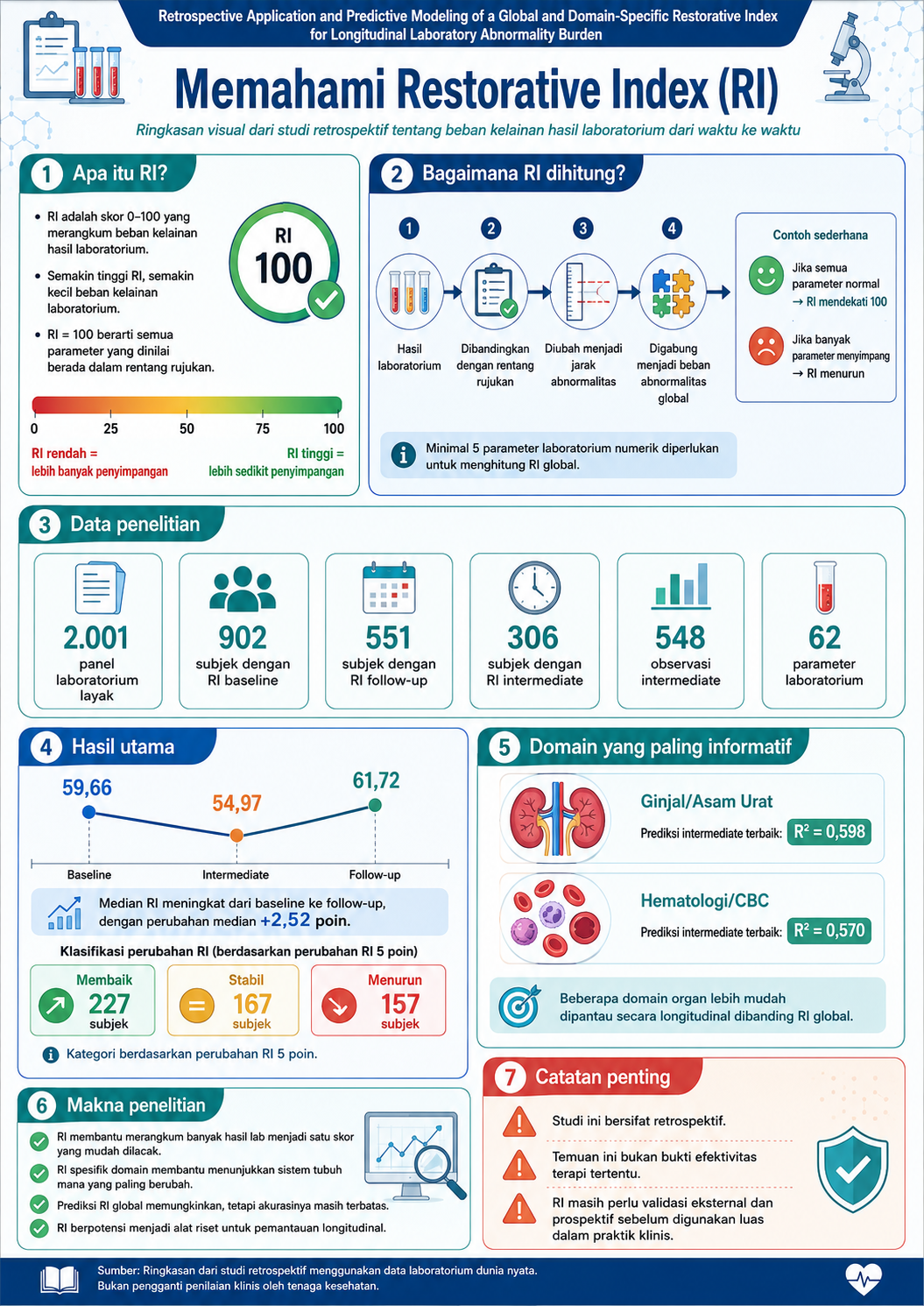
Background. Routine laboratory tests provide multidimensional information about systemic physiology, but their interpretation is usually analyte-specific and may not capture cumulative abnormality burden across biological systems. A laboratory-derived Restorative Index (RI) framework has been formulated to transform normalized laboratory deviations into a bounded 0–100 score, where higher values indicate lower laboratory abnormality burden. This study applied the global and domain-specific RI framework to de-identified longitudinal clinical laboratory data and evaluated its computability, longitudinal behavior, domain decomposition, and exploratory predictability.
Methods. This retrospective application study analyzed de-identified longitudinal laboratory and treatment/dose data. Eligible numeric laboratory values were transformed into normalized abnormality distances relative to reference intervals. Subject-date panels with at least five RI-eligible analytes were used to compute global RI. Domain-specific RIs were computed for predefined biological domains. Subject-date panels were classified as baseline, intermediate, followup, or single-record observations. Exploratory predictive models included regularized linear models, Bayesian regression, tree-based ensemble models, boosting models, support-vector regression, neural networks, and domain-to-global models. Cross-validation used subject-level grouping where repeated observations were present.
Results. The RI framework was applied to 2,001 eligible subjectdate panels. Baseline RI was available in 902 subjects, follow-up RI in 551 subjects, and intermediate RI in 306 subjects, contributing 548 intermediate RI rows. Median global RI increased from 59.66 at baseline to 61.72 at follow-up, with a median change of +2.52 and mean change of +3.28 RI points. Using a 5-point threshold, 227 subjects improved, 167 remained stable, and 157 declined. Global RI prediction was feasible but modest; the strongest global model predicted final RI from the latest known pre-follow-up RI using ExtraTrees, with cross-validated R2=0.417, MAE = 12.24, and RMSE = 15.23. Domain-specific prediction was stronger for renal/uric intermediate RI (R2=0.598) and hematology/CBC intermediate RI (R2=0.570). Same-date global RI could be partially estimated from domain-specific RI features, with the best model achieving R2=0.639, whereas future final global RI prediction from domain RI dynamics was weaker (R2=0.237).
Conclusion. The RI framework was applicable to heterogeneous longitudinal laboratory data and provided a computable, trackable, and biologically decomposable summary of laboratory abnormality burden. Domain-specific RI improved interpretability and selected-domain predictability. These findings support RI as a retrospective laboratory-informatics framework, but RI changes should not be interpreted as treatment efficacy and require prospective external validation against clinical outcomes.
Keywords: restorative index; laboratory medicine; clinical informatics; longitudinal data; abnormality burden; machine learning; predictive modeling; reference intervals; electronic health records; domain-specific biomarkers
Link: https://www.preprints.org/manuscript/202607.0711/v1