RAHO Club E-Magazine Edition 004 Highlights Global Expansion and the Development of IGDS Technology with IMI
16:43, 16 September 2026 by admin
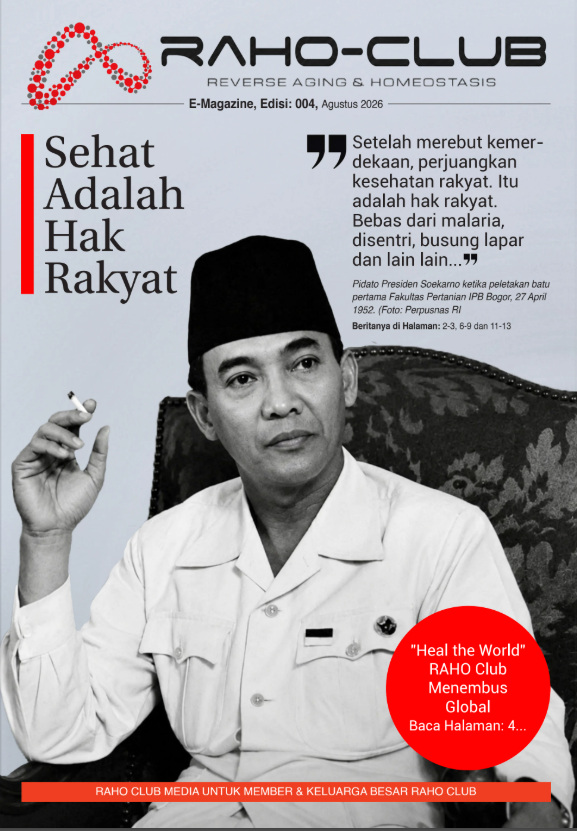
RAHO Club has once again published E-Magazine Edition 004 in August 2026. Carrying the theme “RAHO Club Goes Global,” this edition presents the latest developments in RAHO Club’s efforts to build international networks, advance Intelligent Gas Delivery System (IGDS) technology, provide education on nanobubbles and homeostasis, and share various community activities and member experiences. One of the main highlights is the exploration of collaboration with networks of doctors and partners from Singapore, Malaysia, Cambodia, and India. This initial step was marked by the signing of a Non-Disclosure Agreement (NDA) at RAHO Club Darmo Hill, Surabaya, as part of discussions on opportunities to develop services and research in several countries. The meeting involved, among others, Dr. Steven Tan from Singapore, who works in Cambodia; Alan A. from Trigen Kaizen Malaysia; Dr. Narjid Singh from My Life Center and SMP Group of Clinics Malaysia; and Kan Eddy from RAHO Club Indonesia.
Expanding IGDS Development to a Wider Network
In the report, IGDS, or Intelligent Gas Delivery System, is introduced as a nanobubble-based gas delivery system that forms part of the research journey of RAHO Club together with Yayasan Inovasi Molekuler Indonesia (IMI). The e-magazine highlights Prof. Sutiman Bambang Sumitro and Kan Eddy in the development journey of this technology, while IMI is presented as part of the research ecosystem advancing nanobubble studies.
The meeting with international networks was aimed not only at expanding connections, but also at strengthening documentation and research opportunities. The e-magazine itself emphasizes that the growing body of clinical experiences still requires scientific documentation, publication, and broader research to evaluate effectiveness and safety. This approach is important to ensure that technological development progresses alongside the strengthening of scientific evidence. The collaboration also involves domestic partners. This edition mentions the involvement of MJB Pharma in Pasuruan as one of RAHO Club’s partners in producing infusion fluids used in the development of IGDS nanobubbles. This illustrates that the innovation journey involves not only researchers and healthcare professionals, but also requires support from various stakeholders in building a more integrated technology ecosystem.
Health Innovation and the Spirit of Self-Reliance
Coinciding with the commemoration of Indonesian Independence, Edition 004 also carries the theme of self-reliance in health innovation. In the Main Report, the magazine connects the spirit of independence with efforts to develop science and technology domestically. IGDS is presented in this context as a technology developed by Indonesian researchers to study the delivery of gases in nanobubble form into biological systems. The e-magazine explains that the key issue is not merely the type of gas being used, but also how the gas can be delivered in a measurable way through a delivery system. For IMI, the development of technology such as this needs to remain within a systematic research framework. Nanobubble characterization, biological mechanisms, safety, dosage, standardization, and effectiveness are aspects that must continue to be studied before an approach can be supported by increasingly strong scientific evidence.
From Clinical Experience to Research
This edition also documents the early journey of RAHO Club through the experiences of Kan Eddy and Prof. Sutiman Bambang Sumitro in the development of nanobubbles. Their story is presented as part of a journey that later expanded into the formation of a community, research activities, and the development of broader health programs. A number of individual experiences are also featured, including recovery stories and member experiences with approaches developed by RAHO Club. However, these personal experiences should be understood as individual reports or testimonials, rather than evidence that can automatically be generalized to a wider population. Building stronger evidence still requires appropriately designed research, safety monitoring, and continuous scientific evaluation.
Expanding Health Education for the Public
In addition to research and technology development, RAHO Club E-Magazine Edition 004 also presents a variety of health education articles. One of them discusses the importance of maintaining adequate fluid intake in older adults, given that the sensation of thirst may decrease with age. The article connects adequate hydration with homeostasis, kidney function, circulation, electrolyte balance, and overall body function. Other topics include the relationship between food texture and jaw muscle activity, sleep habits and skin health, as well as education on healthy lifestyles in older age. Through these sections, the e-magazine seeks to combine discussions of health technology with everyday habits that also contribute to maintaining overall well-being.
This edition also records a nanobubble technology education event in Bandung featuring Kan Eddy and dr. Aditya Tri Hernowo, Ph.D. as speakers. The event discussed the principles of nanobubbles and the research developments underlying them. In the context of public communication, forums such as this provide a space to bring together researchers, communities, and the public to discuss advances in health technology.
Strengthening Research Networks from Indonesia
For Yayasan Inovasi Molekuler Indonesia, the publication of RAHO Club E-Magazine Edition 004 also documents the continued expansion of networks surrounding nanobubble research and gas delivery technology. The move toward international collaboration opens opportunities for knowledge exchange, cross-institutional research development, and stronger scientific publication. At the same time, expanding these networks also brings a responsibility to maintain scientific integrity, research standards, data transparency, and continuous evaluation of safety and effectiveness at every stage of development. Through collaboration among researchers, physicians, academics, industry partners, communities, and international partners, IMI continues to encourage molecular innovations developed in Indonesia to be tested, documented, and communicated scientifically to a broader audience.
RAHO Club E-Magazine Edition 004, August 2026 can be accessed through the following link:https://online.fliphtml5.com/jgbxb/ifkq/#p=1