
Targeting the Tumor Microenvironment with Oxyhydrogen Nanobubbles
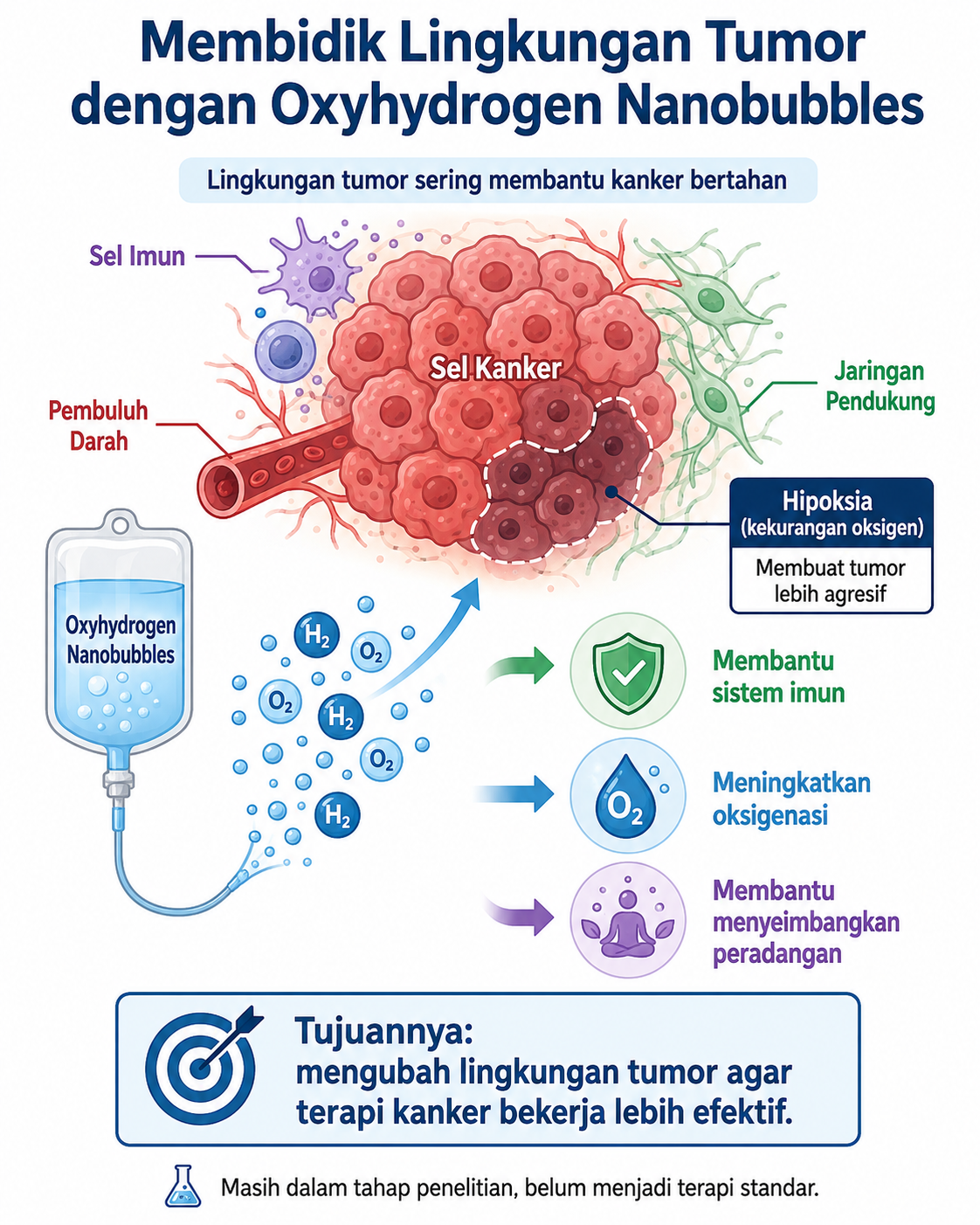
Cancer treatment is often imagined as a way to directly “kill” cancer cells. However, modern research shows that cancer does not exist in isolation. Cancer cells grow within a special environment known as the tumor microenvironment. This environment consists of many components, including immune cells, blood vessels, supporting tissues, and various chemical signals that communicate with one another. In other words, cancer is not merely a group of cells growing uncontrollably, but rather a biological “community” that can adapt and survive inside the body. The problem is that the environment surrounding the tumor often helps cancer survive. Some immune cells that should normally attack cancer cells can be “weakened” by the tumor. In addition, supporting cells around the tumor can help form a protective tissue network, making cancer more difficult for the immune system to recognize and attack. In simple terms, a tumor can build a kind of “biological fortress” that makes it stronger and harder to control.
One important condition within the tumor environment is hypoxia, a state in which tissue does not receive enough oxygen. Tumors often grow rapidly, but the blood vessels that form around them are usually irregular and unable to deliver oxygen evenly. As a result, some areas of the tumor become oxygen-deprived. This condition can make cancer cells more aggressive, more resistant to therapy, and better able to evade the immune system. For this reason, researchers are beginning to see that targeting the tumor environment may become an important strategy in the development of future cancer therapies. This is where the concept of oxyhydrogen nanobubbles becomes interesting. Nanobubbles are extremely tiny gas bubbles, far smaller than ordinary bubbles. Because of their very small size, these bubbles can move more stably in fluids and may potentially carry gas molecules to specific areas within the body. In biomedical research, nanobubbles are being studied as a method for delivering active substances or medical gases more precisely, allowing their effects to be more focused on target tissues while minimizing spread to healthy tissues.
Oxyhydrogen nanobubbles carry gases such as hydrogen (H₂) and oxygen (O₂) in the form of nanoscale bubbles. Hydrogen is known in biomedical research for its potential to help regulate oxidative stress and inflammation. Meanwhile, oxygen is important because many tumors contain areas with low oxygen levels. Simply put, oxyhydrogen nanobubbles can be imagined as tiny “vehicles” that transport biological gases toward the tumor environment. Hydrogen may help reduce oxidative stress and excessive inflammatory signals, while oxygen may help improve oxygen-deficient tumor tissue. This approach is interesting because it does not only aim to attack cancer cells directly, but also seeks to change the conditions around the tumor so they no longer support cancer growth. If the tumor environment can be made less “comfortable” for cancer cells, then other therapies—such as chemotherapy, radiotherapy, immunotherapy, or molecule-based therapy—may theoretically work more effectively. This is why strategies targeting the tumor microenvironment are increasingly being explored in modern cancer research.
For the Indonesian Molecular Innovation Foundation, this approach aligns with the spirit of molecule-based innovation. Cancer cannot be understood only by looking at the size of a lump or the organ in which it appears. We also need to understand how cancer cells communicate with their surroundings, how much oxygen is available around them, how the immune system responds, and how oxidative stress and inflammation influence disease progression. With this understanding, oxyhydrogen nanobubbles may become an interesting research direction for helping target cancer more precisely. However, it is important to emphasize that the use of oxyhydrogen nanobubbles for cancer is still in the research stage. This technology cannot yet be considered a replacement for standard cancer therapy. Further studies are still needed to determine its safety, proper dosage, best method of administration, most suitable cancer types, and how this technology can be combined with existing medical treatments.
In the end, “targeting the tumor environment” means looking at cancer more comprehensively. Cancer cells are indeed the main target, but the environment around them is often one of the reasons cancer is difficult to control. Oxyhydrogen nanobubbles offer a new concept that combines gas therapy, nanotechnology, and tumor biology. If future studies can prove their benefits and safety, this technology may become part of a more precise cancer therapy strategy in the future
Source: Zahrah, N. A., Widyarti, S., Wuragil, D. K., Riawan, W., Indrajani, O., Lubab, A., Hernowo, A. T., Sumitro, S. B., & Aulanni’am. (2026). Oxyhydrogen nanobubbles suppress FoxP3 and Ki-67 expression in a Wistar rat model of hepatocellular carcinoma. Jurnal Penelitian Pendidikan IPA, 12(1), 771–780.https://doi.org/10.29303/jppipa.v12i1.13858