
Oxyhydrogen nanobubbles attenuate angiogenesis, inflammation, and immunosuppression in Wistar rats hepatocellular carcinoma model
Aulanni'am, Natasya Adiba Zahrah, Sri Widyarti, Olly Indrajani, Dyah Kinasih Wuragil, Wibi Riawan, Dodik Prasetyo, Syifa Mustika, Aditya Hernowo, Sutiman Bambang Sumitro, Ahmad Lubab
ABSTRACT.
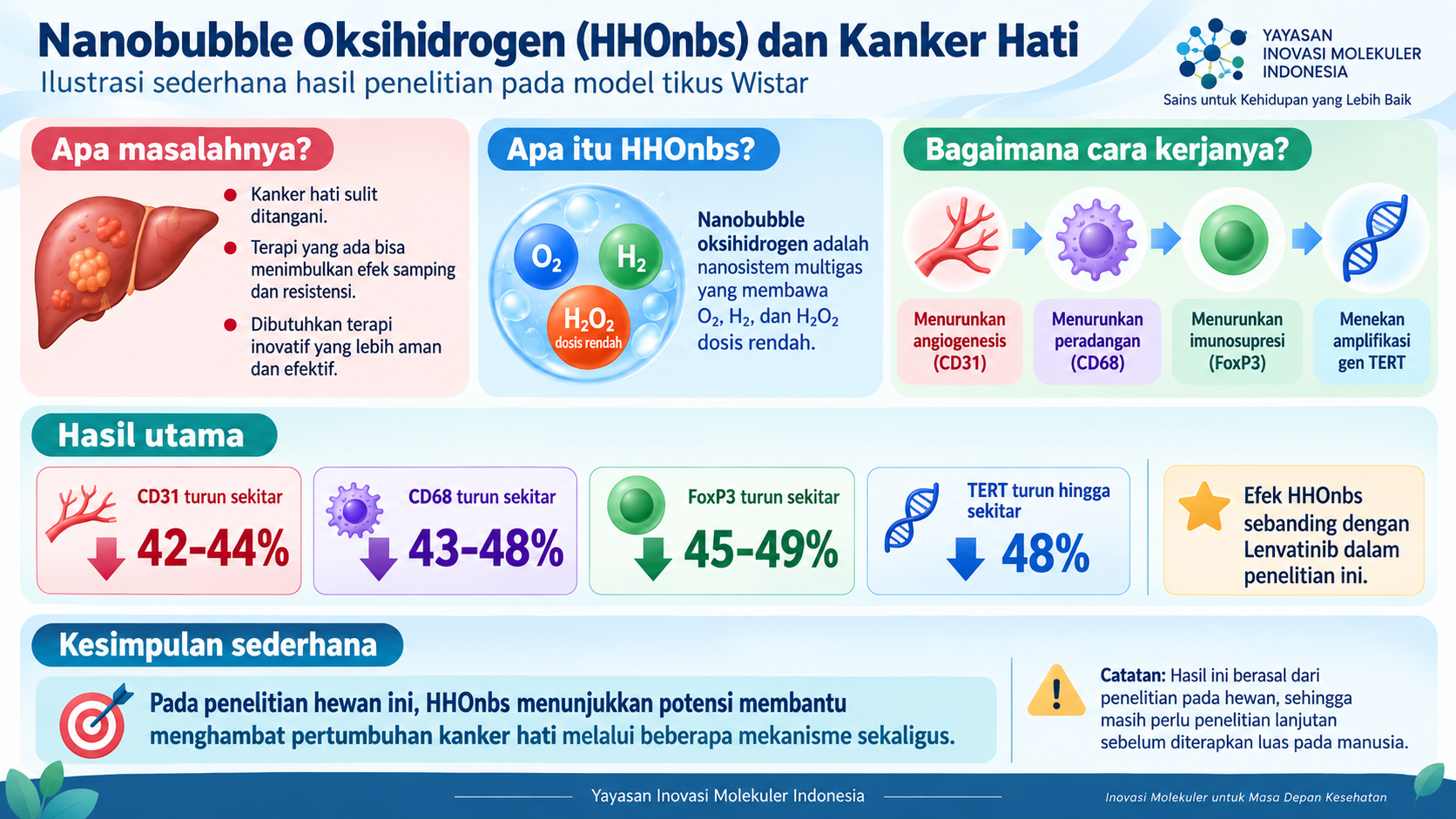
Hepatocellular carcinoma (HCC) remains a major cause of cancer-related mortality worldwide, while currently available first-line therapies are often constrained by systemic toxicity, resistance, and limited single-target mechanisms. Therefore, safer and broader-spectrum therapeutic strategies are urgently needed. This study evaluated the antitumor efficacy of oxyhydrogen nanobubbles (HHOnbs), an innovative multigas nanosystem that simultaneously delivers O₂, H₂, and low-dose H₂O₂, and hypothesized that HHOnbs would suppress HCC progression through multitarget modulation of the tumor microenvironment. A true experimental study was conducted using diethylnitrosamine/carbon tetrachloride (DEN/CCl₄)-induced HCC in male Wistar rats. Six groups were assigned: negative control, positive control, HHOnbs (200 million particles/mL; 0.1 mL per intravenous injection) administered every 2 days for a total of 12 or 24 treatments, and Lenvatinib (1.2 mg/kg body weight, orally) administered in 3- or 5-dose regimens. Antitumor activity was evaluated by immunohistochemical analysis of CD31, CD68, and FoxP3 expression, representing angiogenesis, macrophage-mediated inflammation, and regulatory T-cell-associated immunosuppression, respectively. In addition, TERT gene amplification was quantified using PCR. Compared with the positive control, HHOnbs significantly reduced CD31 by 42.07–43.55%, CD68 by 42.61–48.02%, and FoxP3 by 44.96–48.71% (all p < 0.001), with greater effects observed at higher treatment frequencies. TERT gene amplification was suppressed by up to 47.89% in the 24-administration group. These effects were comparable to those of Lenvatinib, while HHOnbs showed more consistent frequency-dependent responses across all biomarkers. In conclusion, HHOnbs demonstrated significant multitarget antitumor activity in experimental HCC and represent a promising nanotherapeutic candidate for liver cancer management.
KEYWORDS: Hepatocellular carcinoma, oxyhydrogen nanobubbles, TERT, tumor microenvironment