From Research to Healthcare Services: RAHO–IMI Builds an Evidence-Based Ecosystem
18:12, 23 September 2026 by admin
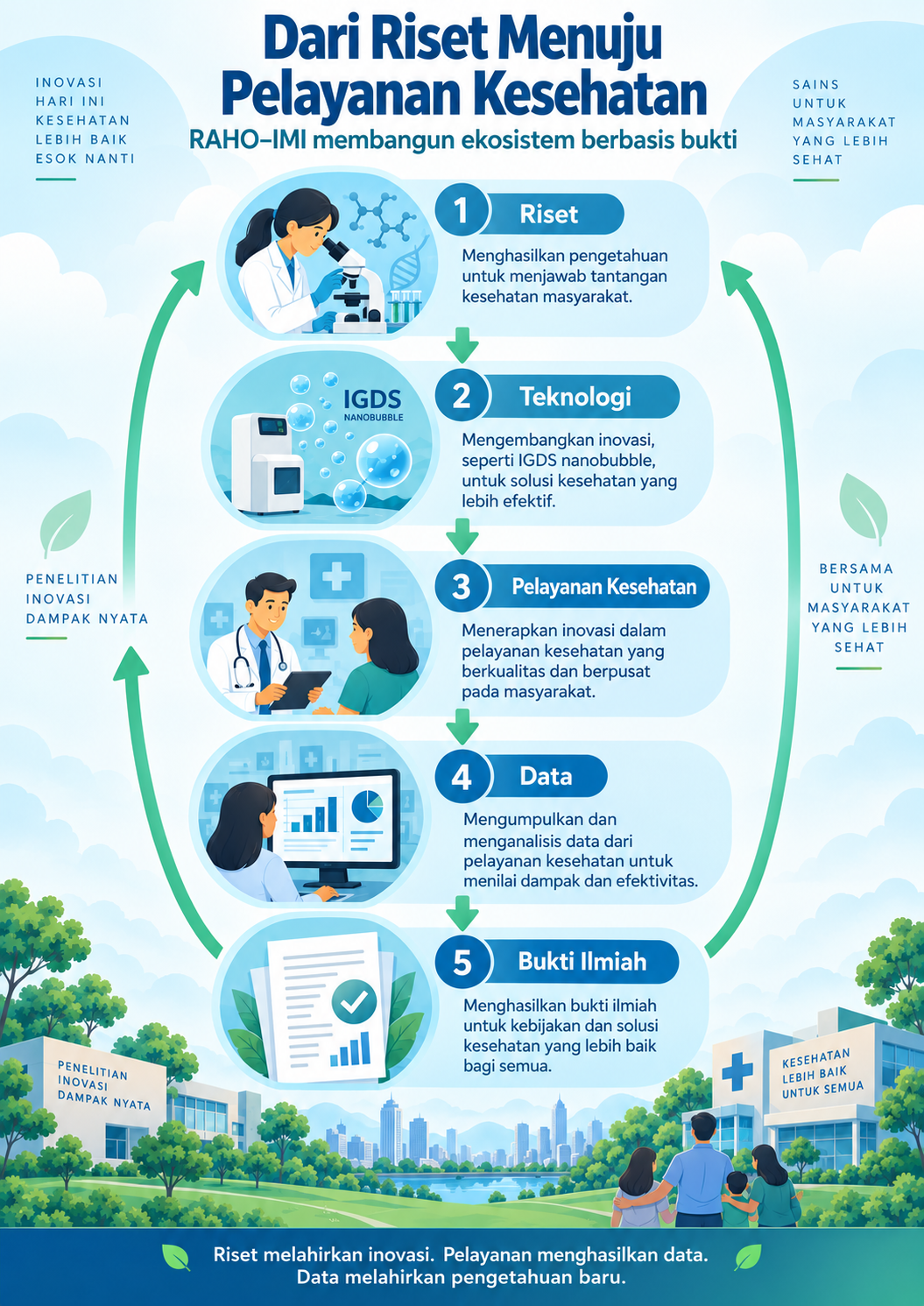
Yayasan Inovasi Molekuler Indonesia (IMI), together with RAHO, continues to develop an ecosystem that connects scientific research, technology development, healthcare services, and data management within an integrated process. Through the RAHO–IMI Research & Healthcare Ecosystem, innovation is expected not to stop at laboratory findings, but to continue being studied through research, measurement, and evaluation so that stronger scientific evidence can gradually be developed. This ecosystem is designed to connect molecular research, technology platform development, preclinical and clinical research, measurement-based healthcare services, data management, and knowledge development.
1. Building an Integrated Research and Innovation Ecosystem
Within the RAHO–IMI ecosystem, each component has a different role, yet all are interconnected. IMI contributes to the development of science and innovation, with areas of study that include molecular biology, gas biology and gasotransmitters, redox balance, mitochondrial function, microcirculation, inflammation, and biological processes related to aging. On the technology development side, the IGDS platform and ultrafine nanobubble technology are studied from various perspectives, including their physical and chemical characteristics, concentration, stability, and production control. These findings can then be further developed through preclinical and clinical research to study mechanisms, safety, biological responses, and other measurable parameters.
The RAHO–IMI research portfolio is not focused on only one particular disease, but on various biological processes that can be studied objectively. Areas of interest include microcirculation and cardiovascular health, neurology and stroke, metabolic health, oncology research, aging and longevity, performance and recovery, as well as gas biology. The parameters studied may include blood vessel function, tissue perfusion or blood flow, cardiac function, medical imaging, metabolic and inflammatory biomarkers, cognitive function, VO₂max, and various other physiological indicators. In gas biology research, molecules such as hydrogen (H₂), oxygen (O₂), nitric oxide (NO), carbon monoxide (CO), hydrogen sulfide (H₂S), and carbon dioxide (CO₂) are studied separately, as each requires its own evidence regarding dose, mechanism, safety, and biological effects.
This approach allows various parties to participate within the same ecosystem, including researchers, universities, physicians and hospitals, manufacturing and diagnostic sectors, as well as experts in intellectual property, regulatory affairs, and digital technology. In this way, innovations arising from research can be developed gradually through structured testing and measurement, rather than relying solely on assumptions or early observations.
2. Connecting Healthcare Services, Data, and Scientific Evidence
One important principle within the RAHO–IMI ecosystem is that every finding should be understood according to the strength of the available evidence. Results from laboratory research, animal studies, or observations in a small number of individuals can provide important early clues, but they do not immediately mean that a method has been proven effective in humans. For this reason, research is carried out step by step, beginning with initial observations and case documentation, followed by small-group studies, safety studies, and eventually larger and more controlled studies. This approach helps ensure that conclusions are based on sufficient data and do not go beyond the evidence currently available.
Data also plays an important role in healthcare services. Each process is carried out in a structured manner, beginning with an initial assessment and physician evaluation, followed by interventions according to established protocols, monitoring of health conditions and safety, and post-service evaluation. When the requirements for research are met, the data may be studied further. Medical decisions remain under physician supervision, while consent, ethics, safety, confidentiality, and accurate data recording continue to be carefully maintained.
The data collected is not simply stored as a record; it can also help answer new questions. For example, if a certain change is observed after an intervention, that finding may become the basis for further research. Researchers can then study it using a more focused approach to determine whether the change occurs consistently and what factors may explain it. In this way, healthcare services can generate data, data can lead to new questions, and research can produce knowledge that may later be used to improve future services.
During the 2026–2027 period, RAHO–IMI plans to strengthen data collection and management so that the information produced becomes more systematic and accountable. Several planned steps include standardizing data recording, strengthening safety reporting, using biomarkers and imaging examinations when needed, and developing well-documented findings into case reports or further studies. In the future, research is also expected to involve larger numbers of participants, be conducted across multiple research centers, and be supported by collaboration with academic institutions and the use of digital technology.
Through this approach, IMI and RAHO share a central principle: research creates innovation, healthcare services generate data, data creates new knowledge, and that knowledge can be used again to improve the quality of healthcare services. The main goal is not simply to produce new innovations, but to ensure that every innovation is carefully studied, clearly measured, and developed based on evidence that can be scientifically accounted for.
You can read the full article at the following link: https://drive.google.com/file/d/1FVhSBoztkanG1GgE7VhSuKxvCK5pxcA1/view?usp=sharing