Changes in VO₂max and Short-Term Tolerability Following Intravenous Oxyhydrogen Nanobubble Administration: A Case Series of Nine Indonesian Navy Personnel
Pudjo D. Laksono, Dwi Cahyo Kartiko, Mochamad Purnomo, Subagjo, Aditya Tri Hernowo, Aning Tyas Kusuma Dewi, Afif Rusdiawan and Athiyah Layla,
Abstract
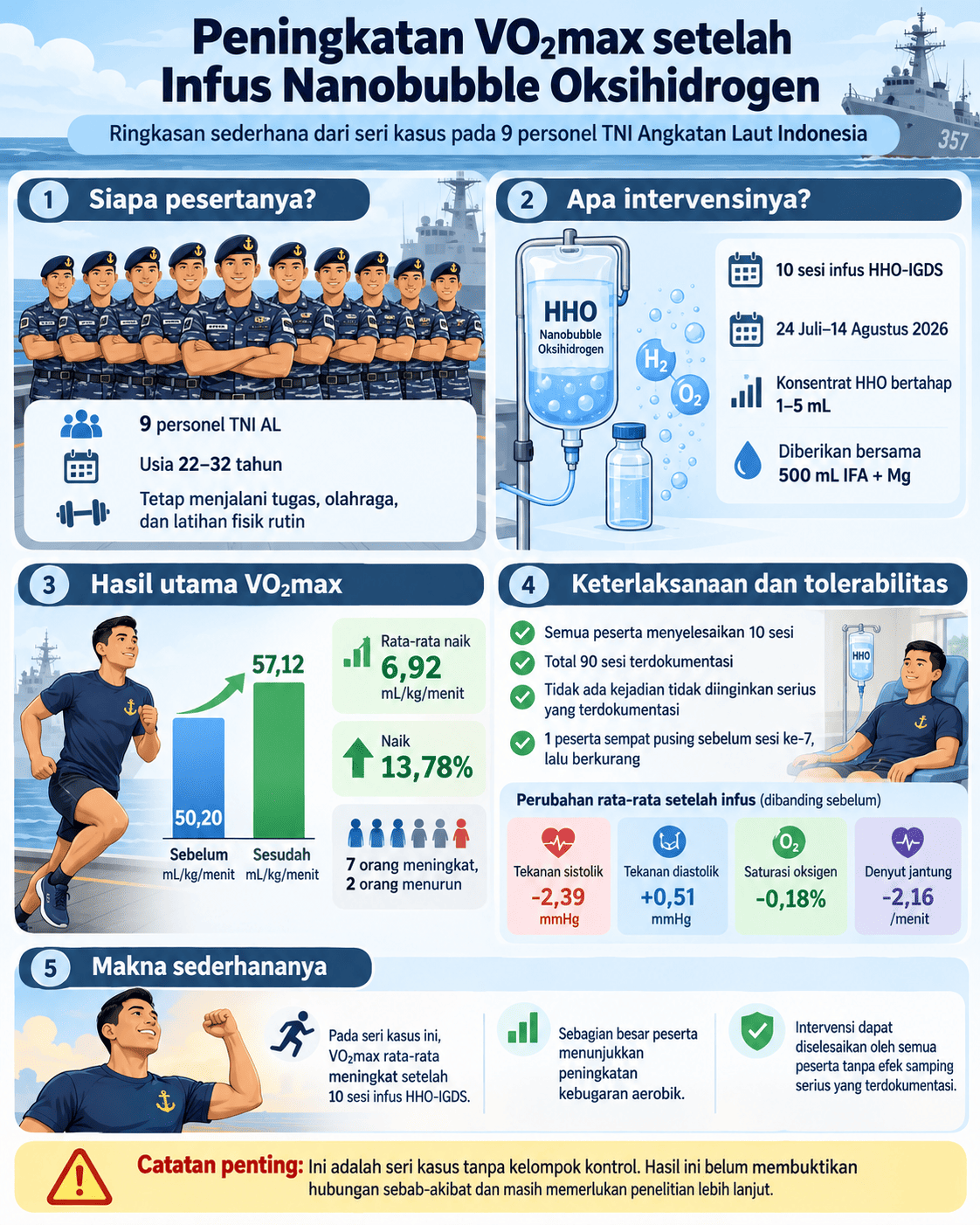
Background: Clinical evidence on intravenous oxyhydrogen nanobubbles and aerobic fitness remains limited. This article reports individual outcomes, intervention completion, and documented tolerability in nine Indonesian Navy personnel who received HHO-IGDS. Participants were monitored from before the intervention through the final assessment. Methods: This case series reports findings from an open-label, uncontrolled study with pre-intervention and post-intervention assessments in nine Indonesian Navy personnel in Surabaya, Indonesia. Nine men aged 22–32 years completed ten scheduled infusion sessions between July 24 and August 14, 2026. The planned regimen increased the volume of HHO concentrate from 1 to 5 mL, administered with 500 mL of a formulation labeled IFA + Mg. All participants continued their military duties, exercise, and routine physical training during the infusion period. Reported VO₂ values, body composition summaries, and pre-infusion and post-infusion observations were reviewed. Changes in VO₂max were analyzed descriptively and using a paired t-test, with the Wilcoxon test as a sensitivity analysis. The magnitude of change was reported as the mean difference with a 95% confidence interval and Cohen’s dz effect size.
Results: Mean VO₂max increased from 50.20 ± 4.98 to 57.12 ± 6.67 mL/kg/min, with a mean change of 6.92 mL/kg/min (95% CI: 2.37–11.47), equivalent to a 13.78% increase relative to the baseline mean. The paired t-test indicated a statistically significant difference (t(8) = 3.51; p = 0.0080), with consistent findings from the Wilcoxon test (p = 0.0195) and a Cohen’s dz of 1.17. Seven participants showed an increase and two a decrease, with individual changes ranging from −2.26 to +15.74 mL/kg/min. All participants completed ten intervention sessions, yielding 90 documented sessions. Mean post-infusion changes relative to pre-infusion values were −2.39 mmHg for systolic blood pressure, +0.51 mmHg for diastolic blood pressure, −0.18 percentage points for oxygen saturation, and −2.16 beats/min for heart rate. No serious adverse events or emergency treatment were documented in the records reviewed. One participant reported dizziness before the seventh session, which diminished afterward.
Conclusion: Mean VO₂max increased significantly after ten HHOIGDS sessions in Indonesian Navy personnel who continued their routine activities and physical training. All participants completed the intervention without documented serious adverse events. These findings describe increased VO₂max in most participants and the feasibility of completing the intervention series.
Keywords: oxyhydrogen; nanobubble; case series; cardiorespiratory fitness; intravenous administration; military personnel; tolerability
Article Link: https://www.preprints.org/manuscript/202610.2397