The Anti-Aging Secret of Hydrogen: From Hydrogen-Rich Water to Nanobubble Technology
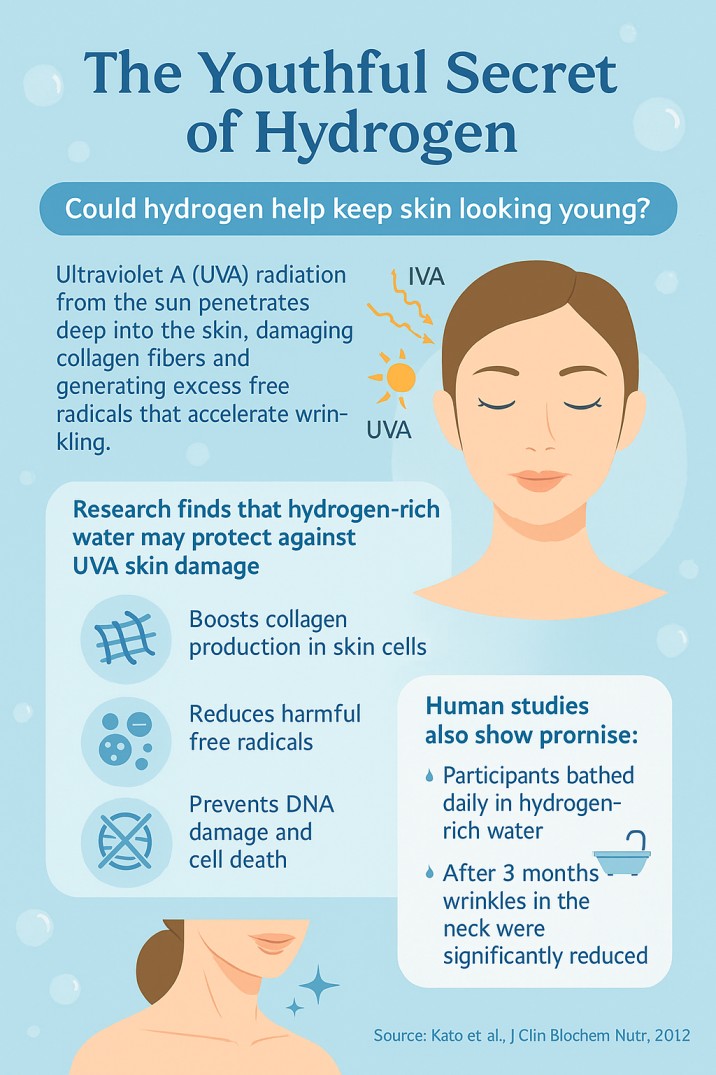
Everyone wants healthy, youthful-looking skin. However, one of the main factors that accelerates skin aging is exposure to ultraviolet A (UVA) rays from the sun. Unlike UVB, which only penetrates the outer layer of the skin, UVA rays can reach deeper into the dermis, the layer rich in collagen. Prolonged exposure damages collagen and elastin fibers, leading to sagging skin, wrinkles, and faster visible aging. In addition, UVA stimulates the excessive production of free radicals (reactive oxygen species/ROS). These free radicals act like “molecular toxins” that attack DNA, proteins, and cell membranes, worsening tissue damage.
A study from Japan by Kato and colleagues (2012) revealed an interesting and simple way to counteract UVA’s harmful effects—using hydrogen-rich warm water. In their laboratory research, the team studied fibroblasts, the cells responsible for producing type I collagen, a protein essential for skin firmness and elasticity. They found that fibroblasts exposed to hydrogen-rich water produced significantly more collagen—about 1.8 to 2 times higher compared to those immersed in regular water. This indicates that hydrogen helps the skin maintain its structural integrity, making it less prone to sagging and wrinkling. The benefits were also seen in keratinocytes—the main cells in the outer layer of the skin. Normally, keratinocytes are severely damaged when exposed to UVA. However, in hydrogen-rich water, they were better protected. Hydrogen reduced the production of harmful free radicals, thereby lowering oxidative stress. As a result, more keratinocytes survived, and DNA damage in the cell nucleus was significantly reduced. In other words, hydrogen not only protects the skin from the outside but also works at the molecular level to keep cells healthier.
The study did not stop at the laboratory. A small clinical trial involving six healthy volunteers—five women and one man—was conducted in a simple way: daily bathing with hydrogen-rich warm water for three months. The results were surprising. In four out of six participants, wrinkles in the back of the neck were significantly reduced after 90 days. Skin replica analysis and before-and-after photos showed a clear reduction in fine lines, making the skin appear firmer and more youthful. These findings provide compelling evidence that hydrogen, though a simple gas, has great potential as a natural antioxidant. Hydrogen can selectively neutralize the most harmful free radicals without interfering with other important molecules in the body. If hydrogen-rich water already shows promising results, then more advanced technologies such as nanobubbles—currently being developed at the Institut Molekul Indonesia (IMI)—could make hydrogen’s benefits even greater, since nanobubbles allow hydrogen to remain stable in liquid longer and penetrate deeper into skin and body tissues.
From Hydrogen Water to Nanobubble Technology at IMI
The study by Kato and colleagues demonstrates that hydrogen can provide real protection for the skin. However, one limitation of ordinary hydrogen-rich water is that hydrogen quickly evaporates, and its concentration in water decreases within minutes to hours. This is where nanobubble technology becomes a breakthrough. Nanobubbles are ultra-microscopic gas bubbles—about 100 times smaller than red blood cells. Their tiny size makes them far more stable in liquid compared to ordinary bubbles, lasting not just minutes but days.
At the Institut Molekul Indonesia (IMI), nanobubble technology is being intensively studied for various medical applications. By encapsulating hydrogen into nanobubbles, the gas not only lasts longer but also penetrates deeper into body tissues. For skin health, this means hydrogen can work more effectively to neutralize free radicals, repair damaged cells, and stimulate collagen production. Beyond skincare, hydrogen nanobubbles are also being explored for chronic disease therapies, enhancing oxygen delivery to tissues, and supporting the immune system in combating inflammation. In other words, nanobubble technology expands hydrogen’s role from being simply “healthy water” to becoming a promising future medical therapy.
Source:
-
Institut Molekul Indonesia. (2025, May 30). Small bubbles, big hope: Oxyhydrogen nanobubble therapy for chronic kidney disease patients. Institut Molekul Indonesia. https://www.institutmolekul.id/blog/small-bubbles-big-hope-oxyhydrogen-nanobubble-therapy-for-chronic-kidney-disease-patients
-
Kato, S., Saitoh, Y., Iwai, K., & Miwa, N. (2012). Hydrogen-rich electrolyzed warm water represses wrinkle formation against UVA ray together with type-I collagen production and oxidative-stress diminishment in fibroblasts and cell-injury prevention in keratinocytes. Journal of Photochemistry and Photobiology B: Biology, 106, 24–33. https://doi.org/10.1016/j.jphotobiol.2011.09.006