
Stability of Hydrogen and Oxyhydrogen Nanobubbles: Addressing the Challenges of Temperature and pH
Nanobubbles—ultra-small gas bubbles less than 200 nanometers in diameter—are now gaining attention in the field of healthcare. Their tiny size allows them to penetrate tissues, serve as drug delivery carriers, and even act as therapeutic gas vehicles such as hydrogen. However, the biggest challenge of this technology is stability. Can nanobubbles remain intact under different environmental conditions, or do they easily burst and disappear?
A recent study from the Indonesian Molecule Institute evaluated how nanobubbles containing two types of gases—pure hydrogen (H₂) and oxyhydrogen (HHO)—withstand extreme temperatures and varying acidity (pH) levels.
Testing Nanobubble Endurance
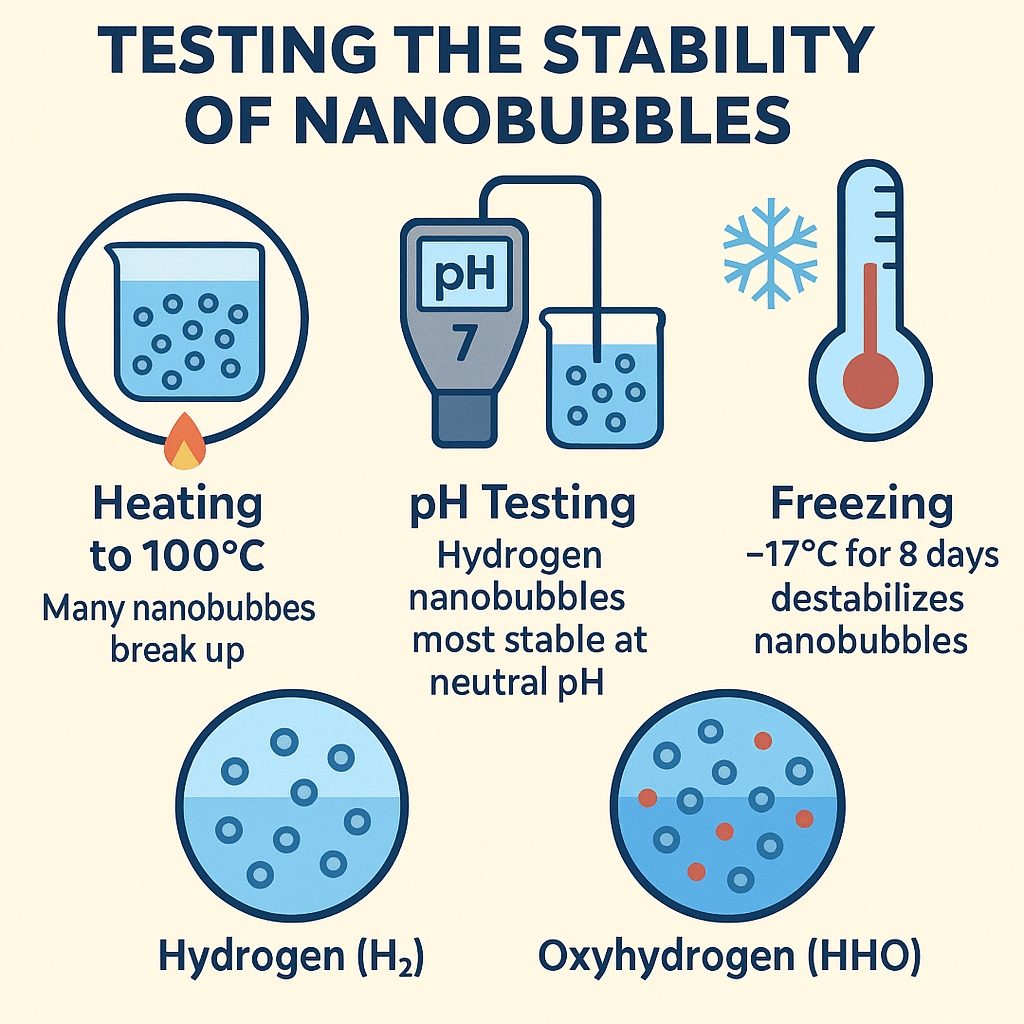
In this study, scientists attempted to test nanobubbles under different conditions to see how resilient these tiny bubbles are. For oxyhydrogen (HHO) nanobubbles, the results were quite striking. When heated to boiling temperature (100°C), many nanobubbles burst. The bubbles enlarged and their numbers dropped drastically as the heat forced the gas inside them to escape. At a lower temperature of about 80°C, nanobubbles could still survive, though their size changed. Meanwhile, when frozen at −17°C for eight days, the nanobubbles also lost their stability. This happened because ice crystals damaged the bubble walls—like tiny balloons whose surface cracked under external pressure.
A different story emerged with pure hydrogen (H₂) nanobubbles. Instead of being tested with heat, these nanobubbles were placed in solutions with different acidity levels (pH). The findings were interesting: nanobubbles were most stable at neutral pH, between 6 and 7—the same as the natural pH of the human body. This means our body is essentially the perfect “home” for hydrogen nanobubbles. However, in very acidic environments (pH 4–5), nanobubbles quickly degraded as large amounts of hydrogen ions disrupted their structural balance. On the other hand, in alkaline environments (pH 8–9), nanobubbles remained relatively stable, but after a few days their number and size began to change.
In other words, this research shows that nanobubbles are fragile entities, highly influenced by their environment. They can thrive when placed in “friendly” conditions—normal temperature and neutral pH—but are easily destroyed under extreme conditions such as boiling heat, freezing, or high acidity. These findings are crucial for the medical field, as they provide insights into the best ways to store and utilize nanobubbles so they can truly function as therapeutic agents or drug delivery vehicles.
Why Are These Findings Important?
The study reveals that nanobubbles remain most stable under conditions that resemble the human body—normal temperature and neutral pH. This means that, naturally, our body can provide the right environment for nanobubbles to work. For medicine, this is exciting news. Nanobubbles have great potential to be used in hydrogen infusion therapy, known for its antioxidant and anti-inflammatory effects, or even as “mini vehicles” to deliver drugs directly to targeted cells.
At the same time, the study also warns that nanobubbles are vulnerable to damage if stored or used under extreme conditions such as high heat, freezing, or overly acidic or alkaline environments. Therefore, for this technology to be truly implemented in hospitals or clinics, proper storage methods and special formulations are needed to keep nanobubbles stable until they reach the patient’s body. With this understanding, nanobubbles are not just an intriguing concept in the lab, but may become a real breakthrough in future medical therapies.
Source:
Agustin, V., & Hernowo, A. (2025). Stability evaluation of oxyhydrogen and hydrogen nanobubbles under thermal and pH stress conditions. Research Square. https://doi.org/10.21203/rs.3.rs-7269183/v1