
Potential of HHO Nanobubble Therapy for Patients with Rheumatoid Arthritis
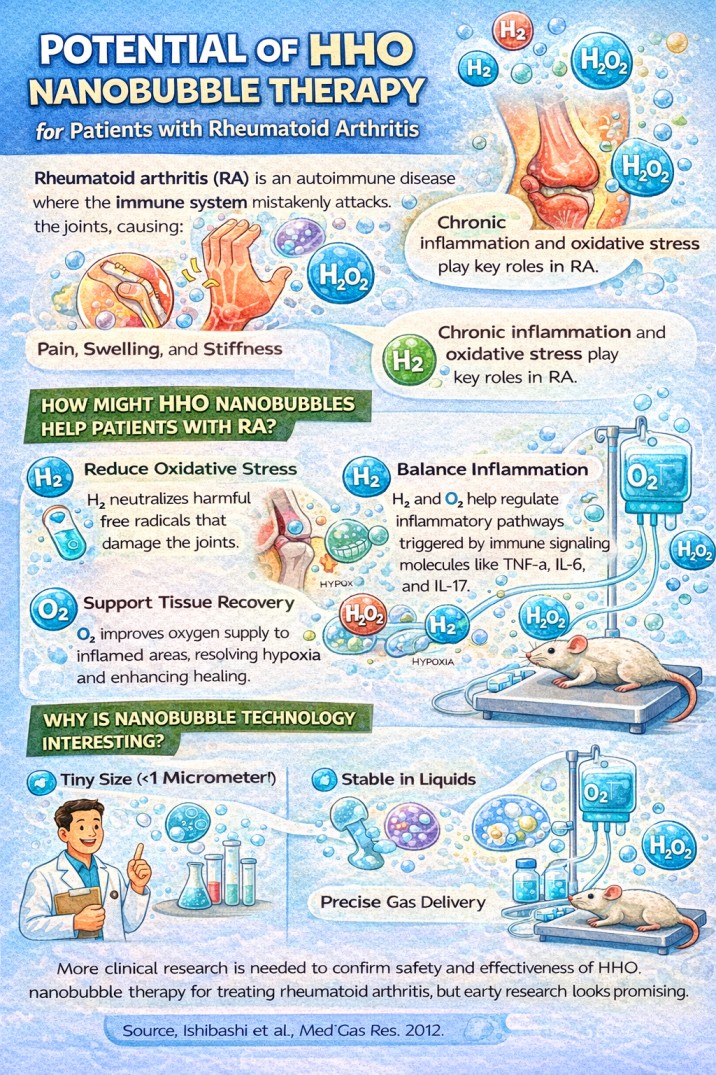
Rheumatoid arthritis (RA) is a chronic autoimmune disease that causes inflammation in the joints. In this condition, the immune system—which normally protects the body from infection—mistakenly attacks the body’s own joint tissues. As a result, patients experience pain, swelling, joint stiffness, and reduced mobility. If not properly managed, prolonged inflammation can damage cartilage and eventually lead to deformities in the joints.
In addition to inflammation, research shows that oxidative stress also plays an important role in the development of rheumatoid arthritis. This condition occurs when there is an imbalance between harmful free radicals and the body’s antioxidant defense system. Such imbalance can worsen inflammation, damage joint tissues, and accelerate disease progression. In recent years, researchers have begun exploring new approaches to help address chronic inflammation in RA. One emerging approach is gas-based nanobubble therapy, particularly oxyhydrogen nanobubbles (HHO nanobubbles).
How Might HHO Nanobubbles Help Patients with RA?
HHO nanobubbles may potentially help patients with rheumatoid arthritis because the combination of gases they contain can influence several biological processes involved in the disease. One of the key factors in RA is oxidative stress, a condition in which the number of free radicals in the body exceeds the capacity of the antioxidant system to neutralize them. These free radicals can damage cells and joint tissues while worsening inflammation. Molecular hydrogen (H₂), which is present in the nanobubble system, is known to have selective antioxidant properties, meaning it can neutralize the most harmful free radicals without interfering with other molecules that are essential for normal cellular functions. By reducing oxidative stress, hydrogen may help protect inflamed joint tissues from further damage.
Rheumatoid arthritis is also characterized by an excessive inflammatory response from the immune system. In RA, the body produces various inflammatory signaling molecules such as TNF-α, IL-6, and IL-17, which trigger swelling, pain, and tissue damage in the joints. Some studies suggest that molecular hydrogen may help modulate inflammatory pathways, allowing the immune response to become more balanced. Within the nanobubble system, oxygen (O₂) also plays an important role because inflamed tissues often experience hypoxia, or low oxygen levels, which can worsen inflammation. By improving oxygen supply to affected tissues, the cellular environment may become more stable and better support the healing process. Meanwhile, hydrogen peroxide (H₂O₂) in very small amounts can act as a biological signaling molecule, helping regulate cellular activity and triggering adaptive protective responses. The combination of these three components within nanobubbles is designed to work synergistically—reducing oxidative stress, balancing inflammation, improving tissue conditions, and supporting the body’s natural protective mechanisms. With this approach, HHO nanobubbles are being explored as a potential supportive therapy that may help reduce the impact of chronic inflammation in rheumatoid arthritis.
Why Is Nanobubble Technology Interesting?
Nanobubble technology is attracting attention in medical research because the gas bubbles are extremely small—often less than one micrometer in size—and remain stable in liquids. Their tiny size allows nanobubbles to move with body fluids and reach tissue areas that are difficult for conventional gas bubbles to access. In this way, medical gases such as hydrogen and oxygen can be distributed more evenly and efficiently throughout the body. This approach opens new possibilities for gas-based therapy because the delivery of therapeutic gases can become more controlled, precise, and stable, potentially maximizing biological benefits while reducing the risk of unwanted side effects.
Although the concept is promising, it is important to understand that the use of HHO nanobubbles for rheumatoid arthritis is still in the stage of scientific exploration and technological development. Researchers are continuing to study how this technology behaves in the body and how it can be applied safely. Some previous studies have shown that molecular hydrogen may help reduce oxidative stress and inflammation in various inflammatory diseases. However, further clinical studies in humans are still required to determine whether HHO nanobubble therapy is truly effective and safe for patients with rheumatoid arthritis. For now, this therapy should be viewed as a promising area of research rather than a standard treatment for RA.
Source
Ishibashi, T., Sato, B., Rikitake, M., Seo, T., Kurokawa, R., Hara, Y., Naritomi, Y., Hara, H., & Nagao, T. (2012). Consumption of water containing a high concentration of molecular hydrogen reduces oxidative stress and disease activity in patients with rheumatoid arthritis: An open-label pilot study. Medical Gas Research, 2(1), 27. https://doi.org/10.1186/2045-9912-2-27