
Ozone Therapy (O₃): How Can This Gas Help the Body Heal?
For most of us, ozone is known as the protective layer in the Earth’s atmosphere that filters harmful ultraviolet radiation from the sun. However, in the medical field, ozone (O₃) is also being studied as a complementary therapy to support various health conditions. At first glance, this may sound contradictory, since ozone is known as a strong oxidizing agent. The key lies in the dose and the method of administration. When used in carefully controlled medical concentrations, ozone is not applied as a toxin, but rather as a stimulus that triggers the body’s natural defense mechanisms.
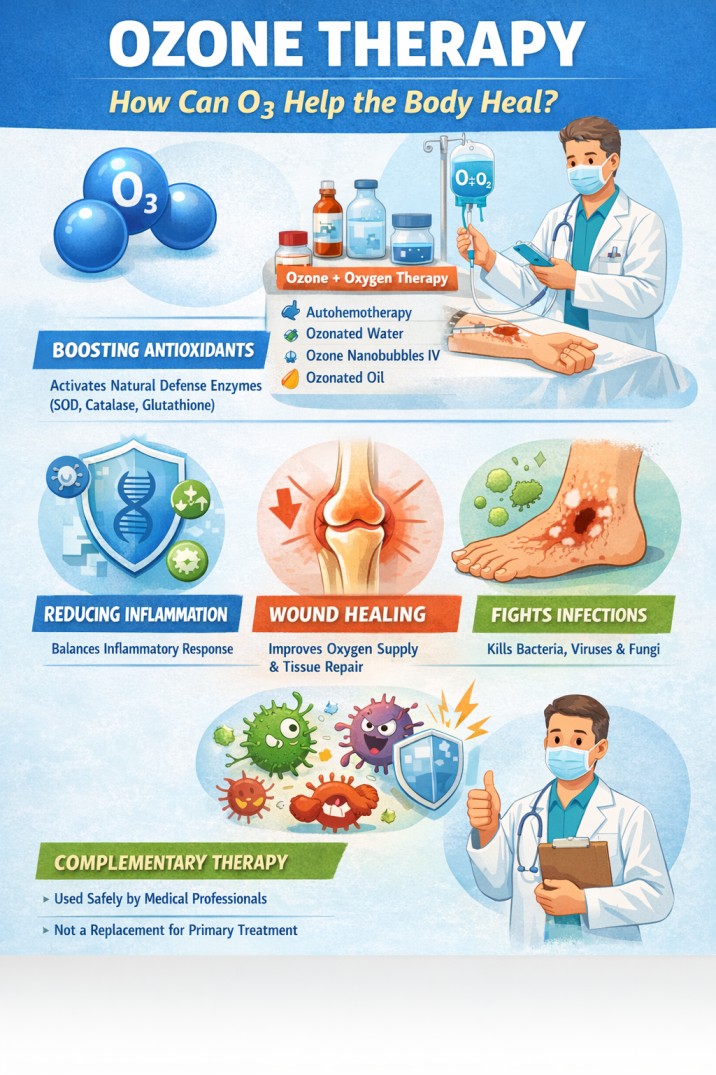
Ozone is a molecule composed of three oxygen atoms. In medical practice, it is mixed with pure oxygen at specific concentrations and administered through safe methods, such as dissolving it in water for wound care, infusing it into oils for topical application, or through autohemotherapy—where a patient’s blood is withdrawn, exposed to an oxygen-ozone mixture under sterile conditions, and then reinfused into the body. In addition, technological innovations have introduced ozone nanobubbles—extremely small gas bubbles that can be dissolved in infusion fluids and administered intravenously under medical supervision. This method is designed to allow more controlled and even distribution. Importantly, ozone therapy must be performed by trained medical professionals, as ozone should never be inhaled directly into the lungs. When properly administered, ozone therapy is used as a complementary approach to support the body’s natural healing processes.
How Does Ozone Therapy Work in the Body?
Although ozone is a highly reactive molecule, at controlled medical doses it does not act as a poison but as a trigger for adaptive biological responses. When ozone reacts with components in the blood, it forms signaling molecules such as small amounts of hydrogen peroxide (H₂O₂). At these low levels, hydrogen peroxide does not cause damage; instead, it acts as a mild “alarm signal” for cells. This signal activates a protective pathway known as Nrf2, which increases the production of key antioxidant enzymes such as superoxide dismutase (SOD), catalase, and glutathione peroxidase. In simple terms, ozone therapy helps strengthen the body’s own defense system against oxidative stress.
Beyond enhancing antioxidant defenses, ozone therapy at appropriate doses also helps modulate inflammation. Ozone can influence inflammatory pathways such as NF-κB, which plays a role in the production of pro-inflammatory substances. When inflammation becomes more balanced, swelling decreases, pain is reduced, and tissue repair can proceed more efficiently. This is why ozone therapy is often used as an adjunct treatment in chronic inflammatory conditions, including certain skin disorders and non-healing wounds.
In chronic wounds such as diabetic foot ulcers or pressure sores, ozone therapy has shown potential to accelerate healing. It may improve oxygen delivery to tissues, stimulate the formation of new blood vessels (through growth factors such as VEGF), and enhance the activity of wound-healing cells like fibroblasts, which produce collagen. Ozone also has antimicrobial properties due to its ability to disrupt the cell walls of bacteria, viruses, and fungi. Studies have demonstrated effectiveness against bacteria such as Staphylococcus aureus and Escherichia coli, as well as microorganisms involved in skin infections.
Ozone therapy also affects the circulatory system. It can increase levels of 2,3-DPG in red blood cells, allowing oxygen to be released more easily to tissues that need it. This effect helps improve microcirculation and supports tissues experiencing low oxygen levels (hypoxia), such as those found in chronic wounds or peripheral vascular disorders. Overall, ozone therapy does not replace the body’s functions; rather, it stimulates natural biological mechanisms so that healing processes can occur more efficiently.
Is Ozone Therapy Safe?
According to the scientific literature, ozone therapy is considered safe when used at appropriate medical concentrations, when not inhaled directly into the lungs, and when administered by trained professionals. Excessively high doses may provoke inflammatory responses, which is why strict medical protocols are essential. Based on current research, ozone therapy has been used as a complementary treatment for diabetic ulcers, skin infections, psoriasis, dermatitis, peripheral vascular disease, musculoskeletal pain, and several chronic inflammatory conditions.
It is important to emphasize that ozone therapy is not a replacement for primary medical treatment, but rather a complementary approach that works by stimulating the body’s natural mechanisms—enhancing antioxidant defenses, balancing inflammation, improving circulation, and supporting infection control. As with any medical therapy, its success depends on proper dosing, correct protocols, and professional supervision. Further research is still needed to strengthen clinical evidence and determine the most appropriate indications for its use.
Source:
-
Liu, L., Zeng, L., Gao, L., Zeng, J., & Lu, J. (2023). Ozone therapy for skin diseases: Cellular and molecular mechanisms. International Wound Journal, 20, 2376–2385. https://doi.org/10.1111/iwj.14060
-
Smith, N. L., Wilson, A. L., Gandhi, J., Vatsia, S., & Khan, S. A. (2017). Ozone therapy: An overview of pharmacodynamics, current research, and clinical utility. Medical Gas Research, 7(3), 212–219. https://doi.org/10.4103/2045-9912.215752
-
Scassellati, C., Galoforo, A. C., Bonvicini, C., Esposito, C., & Ricevuti, G. (2020). Ozone: A natural bioactive molecule with antioxidant property as potential new strategy in aging and in neurodegenerative disorders. Ageing Research Reviews, 63, 101138.https://doi.org/10.1016/j.arr.2020.101138