Nanotechnology for Delivering Therapeutic Gases: A Safer and More Advanced Approach in Modern Medicine
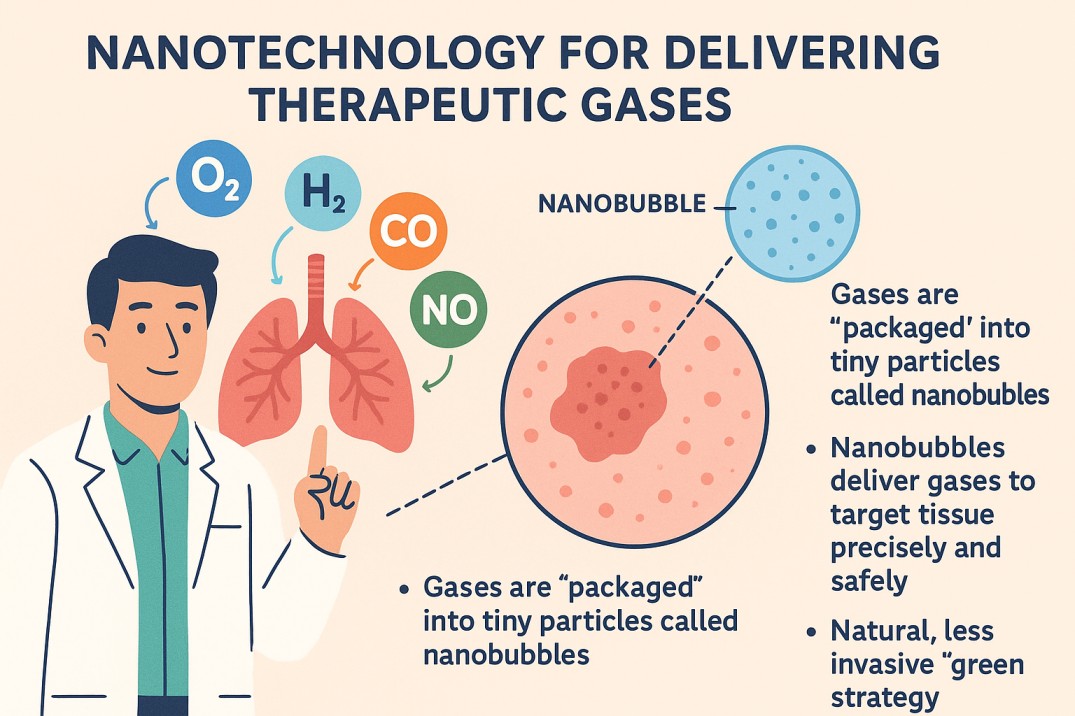
Gases such as oxygen, hydrogen, carbon monoxide, and nitric oxide have long been recognized as important molecules within the human body. Many of these gases play essential roles in maintaining blood vessels, regulating metabolism, reducing inflammation, and supporting the nervous system. However, despite their significant potential, therapeutic gases are difficult to use effectively in treatment because they tend to evaporate quickly, are hard to direct to specific tissues, and can be unstable when administered in their free form.This is where nanotechnology creates a major breakthrough. Scientists are now developing nanotechnology-based gas delivery systems—a new way to deliver therapeutic gases more safely, accurately, and efficiently.
Why Do Therapeutic Gases Need to Be “Packaged”?
Therapeutic gases have great potential to support the body, from improving blood flow and reducing inflammation to assisting tissue repair. But gases naturally spread quickly and may disappear before reaching the tissues that need them. Their dosage is also difficult to control—too little is ineffective, while too much may cause harm or accumulate in unintended areas. Another challenge is that gases cannot be directed precisely to specific organs or cells. To overcome these limitations, researchers developed nanocarriers, particularly nanobubbles, which are extremely small particles capable of transporting and storing gases safely inside the body. With nanocarriers, therapeutic gases can be delivered directly to their target and released slowly as needed, optimizing their benefits while minimizing side effects.
How Do Nano-Based Gas Delivery Systems Work?
Nano-based gas delivery systems work by “packaging” a gas or its precursor into very small particles such as nanobubbles. Once inside the body, these particles can circulate through the bloodstream without easily breaking or dissipating. When the nanocarriers reach tissues that require them—such as areas experiencing oxygen deficiency or inflammation—they release the gas gradually and in a controlled manner. The released gas then helps cells function better, reduces oxidative stress, or supports the healing process. This targeted mechanism allows the gas to work exactly where it is needed, maximizing therapeutic effects while reducing the risk of unwanted side effects.
Why Is It Called a “Green Strategy”?
Therapeutic gas delivery using nanotechnology is considered a “green strategy” because it relies on natural gas molecules that already exist and function within the human body, such as oxygen or nitric oxide. Unlike aggressive treatments like chemotherapy or radiation, this approach tends to produce fewer side effects. Additionally, nanotechnology allows gases to be released at the right dose and at the right time, preventing excessive or uncontrolled exposure. Many gas delivery systems can also be activated using light, heat, ultrasound, or the body’s own biochemical conditions, making the treatment process gentler and often non-invasive.
Clinical Applications and the Future of This Technology
As research continues to grow, therapeutic gases show increasingly promising clinical applications. Technologies such as perfluorocarbon (PFC) can store oxygen and release it when stimulated by infrared light. Meanwhile, microorganisms like cyanobacteria can produce oxygen directly inside tissues that lack adequate oxygen supply. These strategies have been explored to enhance cancer therapies, improve the effectiveness of radiotherapy, reduce inflammation, and support wound healing. With the ability to store, target, and release gases precisely, nanotechnology opens a new path toward safer, smarter, and more body-friendly therapeutic approaches.
Source:
Chen, M., Xu, T., Song, L., Sun, T., Xu, Z., Zhao, Y., Du, P., Xiong, L., Yang, Z., Jing, J., & Shi, H. (2024). Nanotechnology based gas delivery system: a “green” strategy for cancer diagnosis and treatment. Theranostics, 14(14), 5461–5491. https://doi.org/10.7150/thno.98884