Nanobubbles: The Molecular Orchestra Advancing Precision Medicine
By: Dito Anurogo, M.D., M.Sc., Ph.D.
Amidst the rapid flow of modern medical innovations, there emerges a tiny but powerful player: nanobubbles—microscopic bubbles about 100 nanometers in size. That’s thousands of times smaller than a strand of hair, even smaller than many viruses. Despite their size, nanobubbles have enormous potential: they can pass through biological barriers in the body and deliver drugs directly to disease sites with high precision.
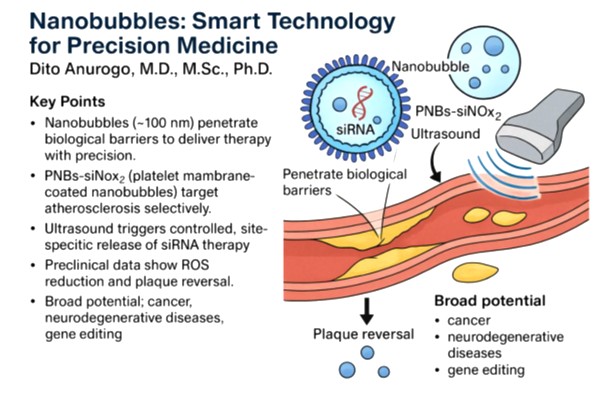
One of the most advanced uses of this technology is the Platelet Membrane-Coated Nanobubbles (PNBs). These nanobubbles are wrapped in platelet membranes—a natural coating from blood cells responsible for clotting and healing damaged blood vessels. This disguise helps the nanobubbles "hide" from the immune system, allowing them to safely circulate in the bloodstream and reach inflamed or damaged areas, such as atherosclerotic plaques—the main cause of heart attacks and strokes.
The main target of this approach is an enzyme called NOX2, which is part of a protein complex known as NADPH oxidase. NOX2 plays a key role in producing Reactive Oxygen Species (ROS)—free radicals that, in excess, damage blood vessels and worsen disease. While ROS are important in small amounts for immune defense, too much of them—often caused by poor lifestyle or high cholesterol—can injure the inner lining of blood vessels, trigger chronic inflammation, and speed up plaque buildup.
To stop this damage, scientists use siRNA (small interfering RNA)—synthetic RNA fragments that can "silence" the NOX2 gene. But siRNA is very fragile; it breaks down easily in the bloodstream and cannot enter cells on its own. This is where nanobubbles come in: they serve as smart, protective delivery vehicles.
With PNBs-siNox2 technology, siRNA is packed inside nanobubbles coated with platelet membranes. This gives them a longer life in the bloodstream and helps them target diseased tissues directly. What makes this system even more impressive is how the therapy is released: using ultrasound (high-frequency sound waves) from outside the body. The ultrasound causes the nanobubbles to vibrate and then burst in a tiny, controlled explosion (cavitation), releasing the siRNA precisely where it's needed—without harming nearby healthy tissues. This allows for on-demand therapy, controlled in both time and space.
A New Medical Paradigm: From “Bombs” to “Molecular Snipers”
Traditional treatments often act like bombs: large doses of drugs are spread throughout the body, hoping that some reach the disease site. This scattershot method often causes side effects. PNBs-siNox2 changes that. It acts like a molecular sniper—accurately hitting only the target, with minimal impact on the rest of the body.
This strategy fits perfectly with the idea of precision medicine—treatment tailored to the specific nature of the disease, its location, and the best timing for delivery. It’s not only more effective but also much kinder to the patient’s body.
Promising Preclinical Evidence
In laboratory studies using ApoE−/− mice (genetically prone to atherosclerosis), PNBs-siNox2 showed exciting results:
- Significantly reduced NOX2 expression.
- Decreased harmful ROS levels in plaque areas.
- Slowed down and even reversed plaque growth—shrinking lesion size by over 80% within just a few weeks. This is far beyond what traditional therapies have achieved.
Beyond Heart Disease: A Versatile Future
The power of nanobubbles extends far beyond cardiovascular disease. This platform is modular and flexible, meaning the contents inside can be swapped for other treatments. In the future, nanobubbles may deliver:
- Growth factors: proteins that help regenerate tissue—useful for chronic wounds or damaged heart tissue.
- mRNA for stem cells: genetic instructions to reprogram local cells into stem-like cells, enabling tissue repair in place without transplant.
- CRISPR-Cas9: a gene editing system that can precisely fix disease-causing mutations in sick cells, while avoiding healthy ones (minimizing off-target effects).
- Combination therapies: for example, delivering anti-inflammatory siRNA and healing growth factors together in a single nano capsule.
By changing the surface of the nanobubbles (e.g., using immune cell or cancer cell membranes instead of platelets), they could be directed to treat cancer, neurodegenerative diseases like Alzheimer’s or Parkinson’s, autoimmune conditions, and possibly even aging.
Embracing the Era of Gentle, Smart Medicine
Nanobubbles reflect a biomimetic approach—learning from nature to create treatments that work with the body rather than against it. This is not just a leap in technology, but a symbol of science guided by empathy and respect for life.
Medicine is evolving—from just extending life to improving quality of life. With better targeting, fewer side effects, and earlier intervention, nanobubbles open the door to a healthier and more meaningful future.
Of course, challenges remain: clinical trials, large-scale production, and long-term safety studies are needed. But the path forward—paved by PNBs-siNox2—is already clear.
Though nearly invisible, nanobubbles could become one of medicine’s most powerful heroes. They show us that sometimes, the smallest solutions hold the greatest power—engineered to heal with precision, care, and compassion.
References
- Hu X, Zhao P, Zhang J, Zhu Y, Zhou W, Hong K, Sun R, Wang Y, Lu Y, Liu Y. Ultrasound-assisted biomimetic nanobubbles for targeted treatment of atherosclerosis. Nanomedicine. 2023 Jul;51:102682. https://doi.org/10.1016/j.nano.2023.102682
- Huang X, Guo H, Wang L, Zhang Z, Zhang W. Biomimetic cell membrane-coated nanocarriers for targeted siRNA delivery in cancer therapy. Drug Discov Today. 2023 Apr;28(4):103514. https://doi.org/10.1016/j.drudis.2023.103514
- Liu, Y., Zhang, Q., Wang, R., Liu, S., Zhang, S., Pan, J., Wang, H., Yu, H., Xia, X., & Zhang, T. (2023). Ultrasound-assisted biomimetic nanobubbles for targeted treatment of atherosclerosis. Bioactive Materials, 29, 1–15. https://doi.org/10.1016/j.nano.2023.102682
- Xu, L., Chen, Y., Jin, Q., Gao, T., Deng, C., Wang, R., Wang, Y., Bai, Y., Xu, J., Wu, W., Li, H., Fang, L., Wang, J., Yang, Y., Zhang, L., Lv, Q., & Xie, M. (2023). A novel ultrasound-responsive biomimetic nanoparticle for targeted delivery and controlled release of nitric oxide to attenuate myocardial ischemia reperfusion injury. Small Structures, 4(6), 2300004. https://doi.org/10.1002/sstr.202300004
- Yin, M., Lin, J., Yang, M., Li, C., Wu, P., Zou, J.-J., Jiang, Y., & Shao, J.-W. (2022). Platelet membrane-cloaked selenium/ginsenoside Rb1 nanosystem as biomimetic reactor for atherosclerosis therapy. Colloids and Surfaces B: Biointerfaces, 214, 112464. https://doi.org/10.1016/j.colsurfb.2022.112464
- Zhang, J., Wang, Z., Liao, Y., Tong, J., Gao, R., Zeng, Z., Bai, Y., Wei, Y., & Guo, X. (2024). Black phosphorus nanoplatform coated with platelet membrane improves inhibition of atherosclerosis progression through macrophage targeting and efferocytosis. Acta Biomaterialia. https://doi.org/10.1016/j.actbio.2024.11.041
- Zhou, J., Niu, C., Huang, B., Chen, S., Yu, C., Cao, S., Pei, W., & Guo, R. (2022). Platelet membrane biomimetic nanoparticles combined with UTMD to improve the stability of atherosclerotic plaques. Frontiers in Chemistry, 10, 868063. https://doi.org/10.3389/fchem.2022.868063