
Nanobubbles and Therapeutic Gases: A New Scientific Approach to Supporting Tissue Recovery
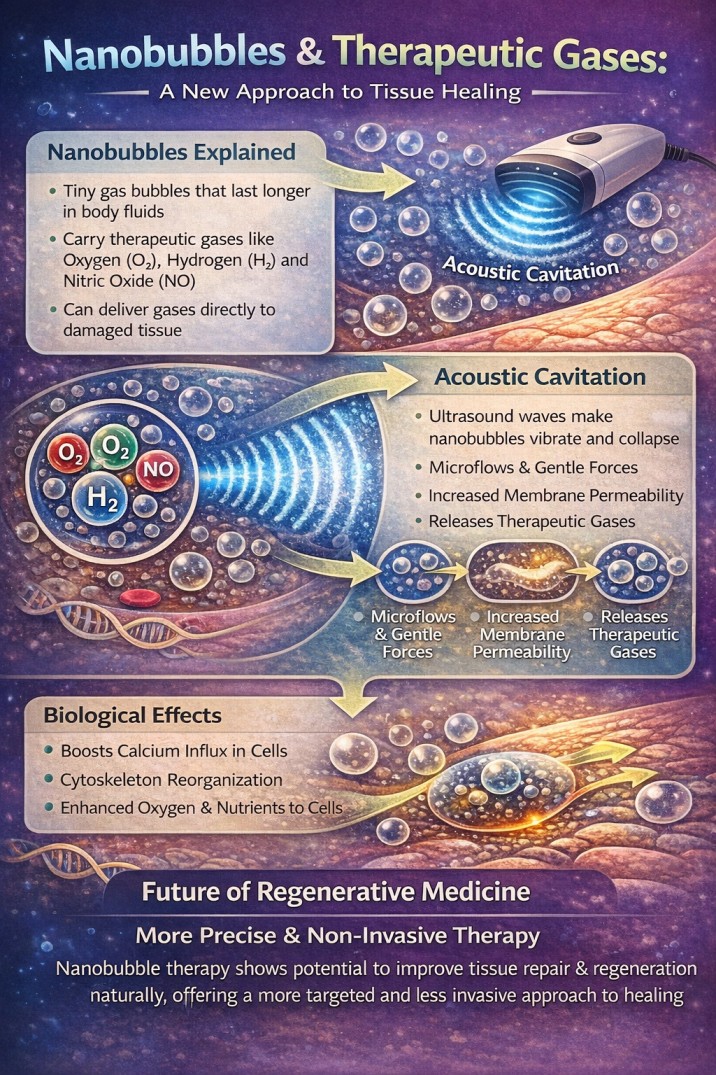
Advances in modern medicine increasingly show that the body’s healing process does not rely solely on chemical drugs or surgical procedures. In recent years, researchers have begun to pay close attention to the role of micro- and nanobubbles, as well as biologically active gases, in supporting tissue recovery and disease therapy. Recent studies explain how nanobubbles, therapeutic gases, and ultrasonic waves can work together to create biological effects that benefit human cells and tissues.
Cavitation: When Bubbles Become a Source of Therapeutic Energy
Nanobubbles are extremely small gas bubbles—far smaller than human cells. Because they exist at the nanoscale, nanobubbles do not behave like ordinary bubbles that quickly rise to the surface and burst. Instead, they can remain stable for long periods in biological fluids such as blood or interstitial fluid, allowing the gases they carry to remain available around cells for a longer time. As research has progressed, scientists have discovered that nanobubbles do not only function as imaging contrast agents, but can also actively participate in biological processes when they interact with ultrasound waves.
When nanobubbles are exposed to ultrasound, a physical phenomenon known as acoustic cavitation occurs. Under these conditions, nanobubbles may oscillate stably, expand and contract, or even collapse rapidly on a microscopic scale. Although this may sound simple, the process produces significant effects at the cellular level. Cavitation can generate gentle mechanical forces on cell membranes, create microflows around cells, and cause temporary changes in membrane permeability. These effects can facilitate the exchange of molecules between cells and their surroundings, enhance the uptake of oxygen or therapeutic gases, and trigger biological signals that support tissue repair and recovery. In other words, ultrasound-activated nanobubbles do not merely deliver gas—they also act as a “physical trigger” that helps cells respond and accelerates natural regenerative processes.
Biological Impacts: From Cells to Tissues
At the cellular level, ultrasound-induced nanobubble cavitation can trigger a variety of important biological responses. The vibration and collapse of nanobubbles generate subtle mechanical stimuli that influence how cells communicate and adapt. One notable effect is an increase in calcium ion influx, which plays a key role in activating cellular signaling pathways. In addition, the cell’s internal structure—known as the cytoskeleton—may undergo reorganization, helping cells become more responsive to their surrounding environment. This process also supports the exchange of oxygen and nutrients, enabling cells to obtain the energy and materials required for self-repair. These effects are highly relevant to tissue regeneration, where healing depends not on a single factor, but on a balance of energy supply, oxygen availability, and a stable microenvironment around the cells.
Although most studies are still at the preclinical stage, nanobubble-based approaches open new opportunities for the development of therapies that are more precise, non-invasive, and aligned with the body’s natural mechanisms. Looking ahead, researchers recognize several challenges that must be addressed, including ensuring long-term safety, controlling ultrasound energy levels to maintain effectiveness without harm, and selecting nanobubble materials that are truly biocompatible. Overall, nanobubble technology is viewed as a bridge connecting physics, biology, and modern medicine. By harnessing simple phenomena—tiny bubbles and sound waves—science is paving the way toward future regenerative therapies that are more advanced, personalized, and focused on the body’s innate ability to heal itself.
Source:
Wu, X., Chen, F., Zhang, Q., & Tu, J. (2024). What is the magical cavitation bubble: a holistic perspective to trigger advanced bubbles, Nano-Sonocatalysts, and cellular sonosensitizers. BME Frontiers, 5, 0067. https://doi.org/10.34133/bmef.0067