Nanobubble Oxygen: A New Hope for Stroke Patients
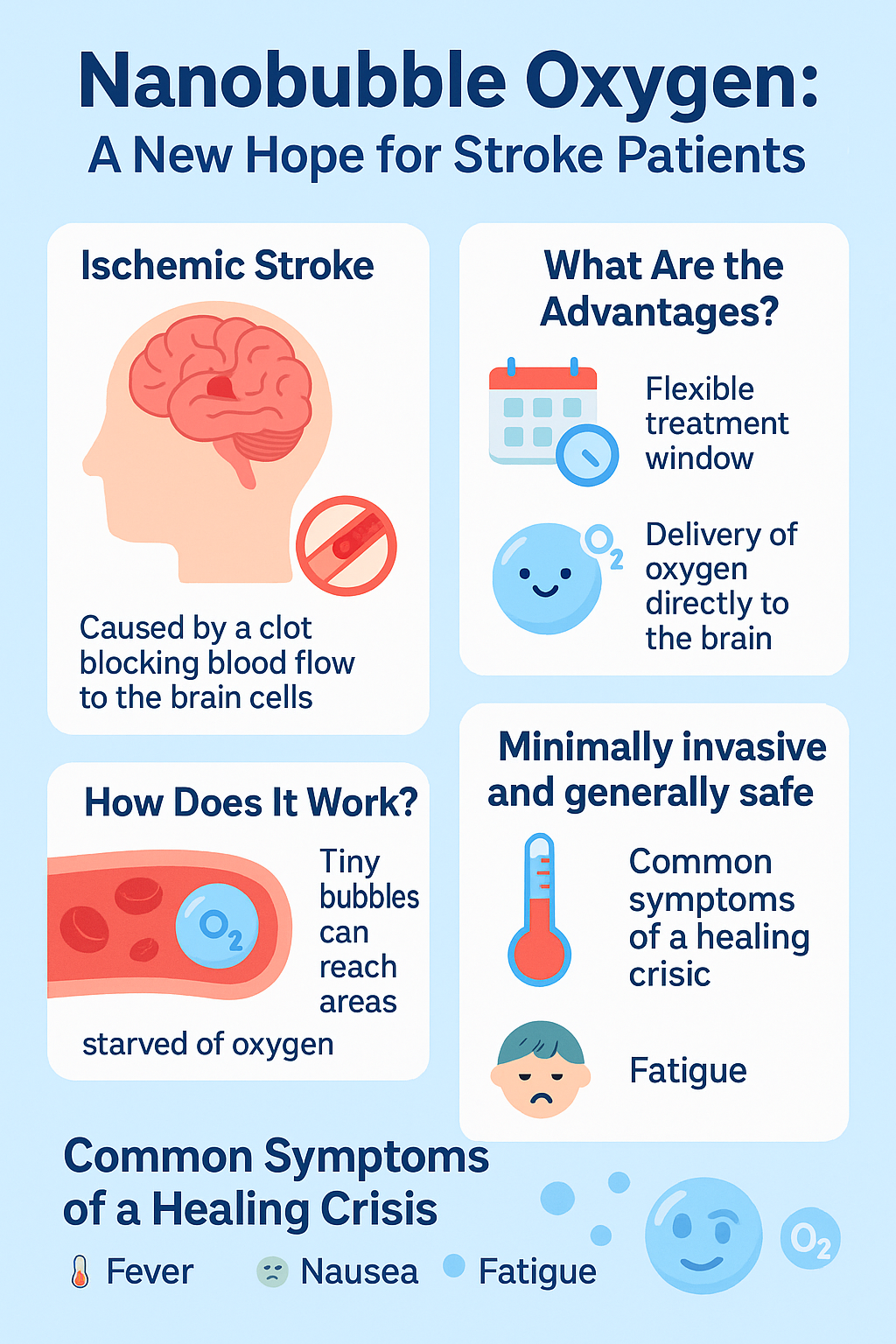
Stroke is a medical emergency that occurs when blood flow to the brain is interrupted. One of the most common types of stroke is ischemic stroke, which happens when a blood vessel is blocked by a clot. As a result, the part of the brain that should receive oxygen becomes deprived, leading to damage and death of brain cells. While treatments like thrombolysis (clot-dissolving drugs) and thrombectomy (clot removal procedures) are available, they can only be given within a limited time frame, and not all patients can receive them in time.
What Is Nanobubble Oxygen and How Does It Work?
Fortunately, the medical world is now developing a new therapy called nanobubble oxygen. Nanobubble oxygen refers to tiny gas bubbles filled with oxygen. These bubbles are much smaller than human cells. Because of their tiny size, they can reach areas of the brain that lack oxygen and release oxygen exactly where it’s needed.
When administered through an IV (infusion), nanobubbles travel through the bloodstream and head toward areas of the brain suffering from hypoxia (low oxygen). Once there, the bubbles slowly burst and release oxygen gradually. This gives brain cells in the penumbra—the area still capable of being saved—an extra “breath of life” to survive and heal. Studies have shown that nanobubble oxygen therapy can accelerate recovery in stroke patients. This treatment helps reduce damage to brain tissue and supports the recovery of movement, speech, and other brain functions that were affected by the stroke. It is also considered safe and easy to administer.
What Are the Advantages Compared to Conventional Therapy?
One major advantage of nanobubble oxygen therapy over standard stroke treatment is its more flexible treatment window. Conventional treatments like thrombolysis must be given within 4.5 hours after stroke symptoms appear. If given later, the risks may outweigh the benefits. However, with nanobubble oxygen, patients who arrive late to the hospital still have a chance to benefit, because this therapy isn’t limited by such strict timing.
Another advantage is its safety profile. Standard stroke treatments can increase the risk of bleeding in the brain, especially in older patients or those with other health conditions. Nanobubbles work differently—delivering oxygen directly to the affected brain tissue. This makes the therapy less risky and potentially safer for more patients.
Additionally, the procedure is minimally invasive. Nanobubbles are usually delivered via IV, without the need for surgery or complex equipment. Because they work at the molecular level, they can reach deep into the brain's smallest blood vessels. Side effects are usually mild, such as temporary dizziness or slight increases in blood pressure, and they typically go away on their own.
Nanobubble oxygen is a promising medical innovation. It works in a smart and natural way—by delivering oxygen directly to where the brain needs it most. With continued research and clinical development, this therapy has the potential to become a key solution for stroke treatment in the future, especially for patients who miss the window for conventional therapy.
Reference
Hamzah, H., Suryanti, S., Ahmed, I. A., Semedi, B. P., Machin, A., & Hernowo, A. T. (2025). Review the role of oxygen-delivering nanobubbles in stroke therapy: A novel approach. F1000Research, 14, 406.https://doi.org/10.12688/f1000research.162742.1