Nanobubble + Magnesium + NO: A New Combination in Modern Medicine
The medical world continues to evolve with various breakthroughs. One of the latest innovations currently under investigation is a combination of hydrogen nanobubbles, magnesium, and nitric oxide (NO) delivered via intravenous infusion. While the concept may sound like it belongs in a high-tech laboratory, this combination holds great potential as a modern therapy—and now, Indonesian researchers are taking the first scientific steps to evaluate its safety.
What Is the Nanobubble, Magnesium, and Nitric Oxide Combination?
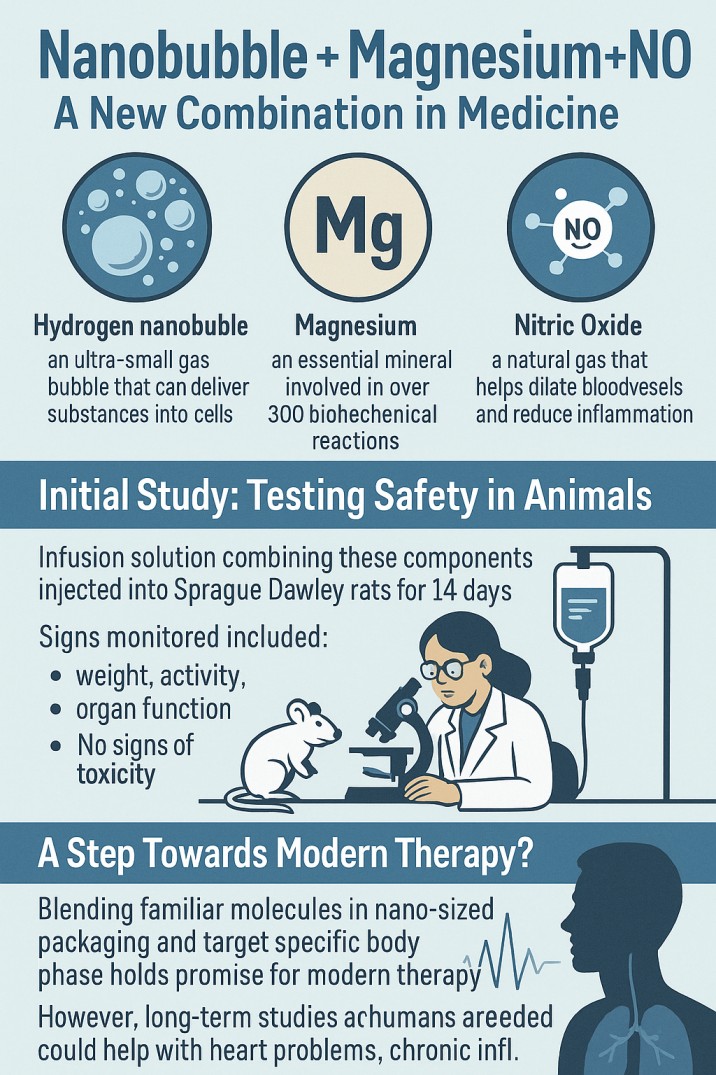
In the field of biology, hydrogen nanobubbles, magnesium, and nitric oxide are three molecules already well known for their benefits to the human body. Hydrogen nanobubbles are ultra-small gas bubbles—thousands of times smaller than the diameter of a human hair—capable of carrying important substances directly into cells. Magnesium, on the other hand, is an essential mineral involved in over 300 biochemical reactions, including those related to muscle, nerve, and heart function. Meanwhile, nitric oxide (NO) is a naturally occurring gas in the body that helps dilate blood vessels and reduce inflammation.What’s interesting is when these three components are combined in an infusion, researchers suspect they act synergistically. This means the combination not only works individually but also supports each other’s effects to help reduce oxidative stress, calm inflammation, and improve cellular and circulatory function. With such promising potential, this trio is considered a strong candidate for modern therapeutic applications across various health conditions. However, before it can be widely used, there’s an important question that must be addressed through research: Is this combination safe to inject directly into the human body? This question is what motivated the preliminary study conducted by Indonesian researchers to evaluate the safety of this infusion in a laboratory setting. The findings represent a critical first step in determining whether this innovative therapy is truly suitable for clinical use.
Initial Study: Testing Safety in Animal Models
To determine whether the nanobubble, magnesium, and nitric oxide combination is safe for infusion, a research team from Jenderal Soedirman University in collaboration with the Indonesia Molecule Institute (IMI) conducted an early-stage trial using lab animals. The study involved 24 Sprague Dawley rats, which were divided into several groups, each receiving different doses of the solution. The goal was to see whether the infusion caused any adverse effects, whether mild or serious. Over a 14-day observation period, the researchers monitored key health indicators such as weight changes, physical activity, and organ function, especially the liver and kidneys. They also performed blood tests and examined tissue samples under a microscope.The results were encouraging. There were no deaths or signs of acute toxicity. In fact, the rats' body weights increased steadily—indicating that they remained healthy and active throughout the study.
In terms of organ function, the liver and kidneys appeared to function normally, although at the highest dose, there was a slight increase in urea and liver enzymes—biomarkers that suggest the body was working harder to process the substances. However, at low to moderate doses, these effects were not observed, and the liver and kidney tissues remained in good condition. Additionally, other vital organs such as the heart, lungs, and spleen showed no signs of damage. These findings suggest that the infusion is relatively safe, at least in animal models and over a short time period. The study provides an essential foundation for determining safe dosage levels, and lays the groundwork for future human clinical trials. Although the results are promising, the researchers emphasize that long-term studies are still needed to confirm safety for regular use.
A New Direction for Modern Medicine: What This Study Means
This early-stage research brings new hope to the medical field. Even though the study was conducted in animals and is still exploratory, the results suggest that the combination of nanobubble, magnesium, and nitric oxide is safe at low to moderate doses. It marks an important milestone before the therapy can be tested in human clinical trials.What makes this combination especially interesting is its approach: using naturally occurring molecules already familiar to the body, packaged with nanotechnology to deliver them directly to where they’re needed—without harming healthy tissues. This reflects a new direction in modern medicine: more intelligent, more targeted, and more body-friendly.
That said, the journey is far from over. The researchers stress the need for larger and longer-term studies, including monitoring for repeated exposure over time. This is essential to confirm long-term safety and evaluate the treatment's effectiveness across different health conditions.Even so, the potential is clear. This combination could be developed to help address various health issues such as cardiovascular diseases, chronic inflammation, and recovery from stroke or injury. If proven safe and effective in humans, this technology may become a part of future infusion therapies—not only for treating disease but also for helping the body heal itself naturally. This study may just be the beginning, but this small step could pave the way for a major transformation in how we understand and treat disease.
Reference:
Novrial, D., Inayati, N. S., Gumilas, N. S. A., Kurniawan, D. W., & Sumitro, S. B. (2025). Evaluating the safety of intravenous injection of nitric oxide, magnesium, and hydrogen nano bubble solution in Sprague Dawley rats. bioRxiv. https://doi.org/10.1101/2025.06.16.659826