
Methylene Blue and Parkinson’s Disease: What Do We Need to Know?
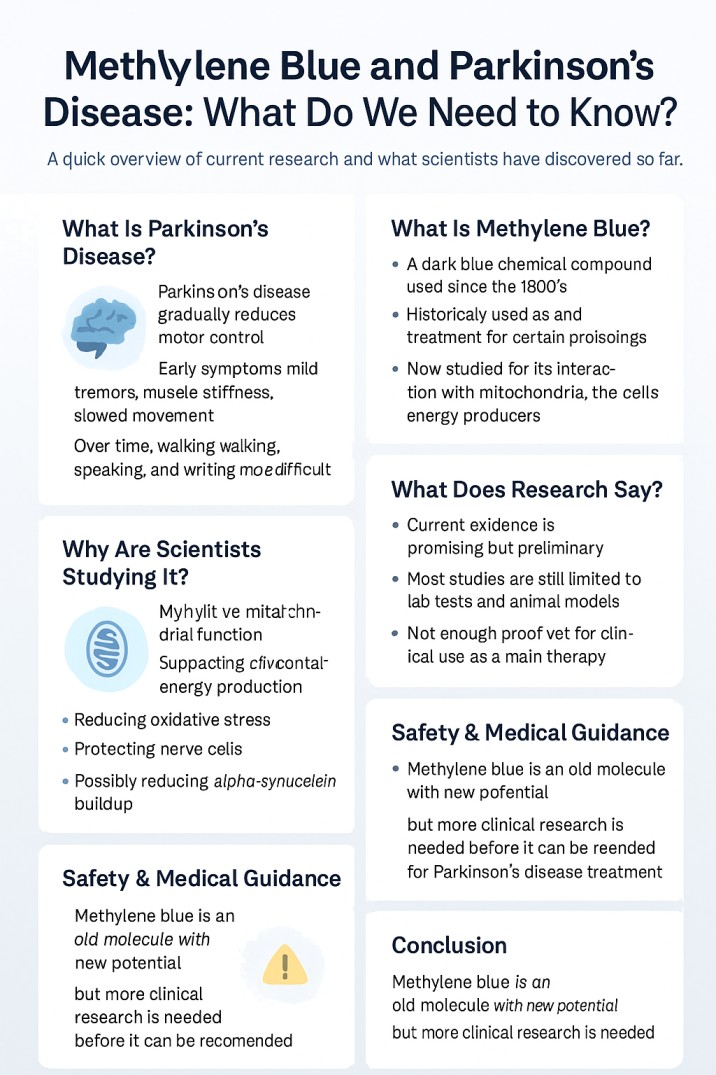
Parkinson’s disease is a condition that gradually causes a person to lose control over their movements. In the early stages, symptoms may appear as mild hand tremors, muscle stiffness, or a general sense that the body is becoming harder to move. Over time, simple activities like walking, speaking, or writing can become challenging. Scientists have been searching for ways to slow down the nerve cell damage that drives this disease.Amid these efforts, renewed interest has emerged in an old molecule called methylene blue. This substance has long been used in medicine, particularly as a dye and as a treatment for certain types of poisoning. Recently, however, methylene blue has caught researchers’ attention again because several studies suggest it may have interesting effects on brain cells—especially in supporting cellular energy and protecting nerve cells.
Even so, it’s important to understand that methylene blue is not yet a primary treatment for Parkinson’s disease. Research is still ongoing, and its use must be strictly supervised by medical professionals. Nevertheless, these early findings offer new hope and continue to fuel scientific interest.
What Is Methylene Blue?
Methylene blue is a dark blue chemical compound that has been known since the 1800s. For many decades, it has been used in medicine for various purposes, from treating certain types of poisoning to assisting laboratory tests and serving as a biological stain in research. What makes methylene blue increasingly interesting to scientists today is its ability to interact directly with mitochondria—the part of the cell responsible for producing energy. Because mitochondria play a crucial role in keeping cells functioning, the potential of methylene blue to support mitochondrial performance has become a major research focus.
Interest in methylene blue grew further when researchers looked into Parkinson’s disease. In this condition, the brain cells that produce dopamine—a chemical essential for coordinating movement—begin to deteriorate. This damage is linked to several factors, including increased oxidative stress (similar to “rusting” of cells), reduced cellular energy, abnormal protein buildup, and mitochondrial dysfunction. Early studies suggest that methylene blue may influence these processes, making it a molecule worth investigating in the context of Parkinson’s disease.
Why Is Methylene Blue Being Studied for Parkinson’s?
Methylene blue has drawn scientific attention because of its ability to interact with mitochondria, the cell’s “power plants.” In people with Parkinson’s, mitochondrial function is often impaired, causing nerve cells to weaken and become more vulnerable to damage. Early research indicates that methylene blue may help stabilize mitochondrial activity, reduce disruptions in energy production, and protect cells from oxidative stress— a state in which excess free radicals cause cellular “corrosion.” The molecule also shows antioxidant-like effects, potentially reducing nerve cell damage and small-scale inflammation in the brain, although these findings are still limited to laboratory and animal studies.
Beyond that, methylene blue is being explored for its potential to reduce the buildup of abnormal proteins, such as alpha-synuclein, which tend to clump together and disrupt communication between nerve cells in Parkinson’s disease. Some studies also suggest that methylene blue may support mental clarity by improving the brain’s energy efficiency, making it relevant to patients who experience cognitive decline. While these early results are encouraging, they remain preliminary and not strong enough to justify methylene blue as a main treatment. In short, this molecule is scientifically intriguing, but its use in Parkinson’s disease still requires much stronger evidence and must always be supervised by trained medical professionals.
Source:
Gureev, A.P., Sadovnikova, I.S. & Popov, V.N. Molecular Mechanisms of the Neuroprotective Effect of Methylene Blue. Biochemistry Moscow 87, 940–956 (2022). https://doi.org/10.1134/S0006297922090073
Poteet E, Winters A, Yan LJ, Shufelt K, Green KN, et al. (2012) Neuroprotective Actions of Methylene Blue and Its Derivatives. PLOS ONE 7(10): e48279. https://doi.org/10.1371/journal.pone.0048279