
Hydrogen: New Hope in the Fight Against Cancer
Cancer, a scary term that is often considered a scourge in the medical world, has sparked much research to find more effective and less risky therapies. One of the most promising recent discoveries is molecular hydrogen (H₂), which has been shown to have various benefits in cancer treatment. Let's explore more about how hydrogen can be a new ally in the fight against this disease.
What is Molecular Hydrogen?
Molecular hydrogen is the lightest and most abundant gas molecule in the universe. Although often considered trivial, molecular hydrogen is now gaining more attention in the medical world. With its strong antioxidant properties, hydrogen is able to neutralize free radicals—compounds that have the potential to damage cells and tissues. Hydrogen is known to have not only antioxidant properties, but also anti-inflammatory and anti-tumor properties.
Hydrogen Production in the Body and Its Relation to Homeostasis
Under normal conditions, intestinal microorganisms in adults can produce large amounts of H2 every day. Hydrogen (H2) is an important energy source for the survival and balance of the growth of intestinal microorganisms. An imbalance of intestinal microorganisms can cause some diseases, such as colorectal cancer. Exogenous H2 supplementation such as through inhalation or oral consumption, or consuming foods rich in fiber and starch, can increase the amount of hydrogen in the body.
Hydrogenogenic (hydrogen-producing) bacteria in the gut use various indigestible carbohydrates as anaerobic energy sources, such as starch, cellulose, and some sugars, and the process then produces large amounts of H2, which can be used by hydrogenotropic (hydrogen-utilizing) bacteria. Hydrogenotropic bacteria produce H2S (hydrogen sulfide), which can cause inflammation and tumors. To overcome this, H2 produced by hydrogenogenic bacteria plays a role in inhibiting the malignant effects of H2S by producing SCFA (short-chain fatty acids) and neutralizing free radicals ROS (reactive oxygen species).
It turns out that H2 metabolism in the intestine not only plays an important role in gut health, but is also important for immune homeostasis (balance) in various other organs in the body. Hydrogen produced in the intestines can penetrate the abdominal cavity and bloodstream, and provide protection to various organs of the body such as the brain, lungs, liver, and other organs from ischemia-reperfusion (lack of blood flow followed by restoration of blood flow), so that it can fight the occurrence of various diseases such as Alzheimer's, Parkinson's, lung cancer, asthma, heart disease, and liver disease. Hydrogen supplementation can also overcome damage to the testes and ovaries caused by oxidative stress, and supporting the restoration of the function of these organs.
How Can Hydrogen Fight Cancer?
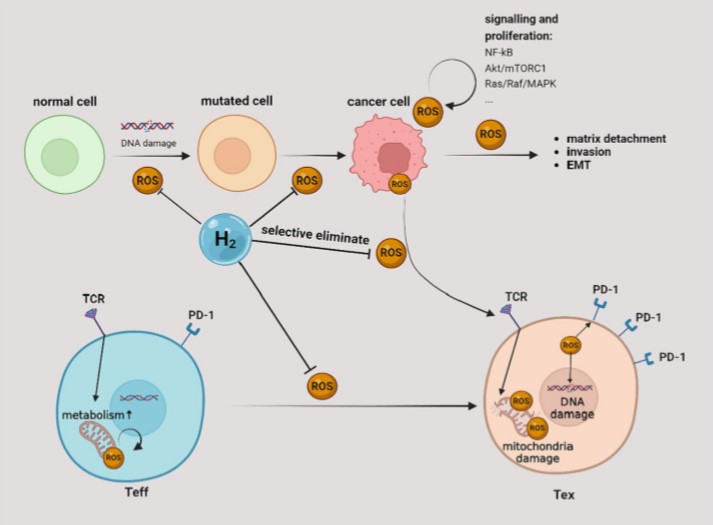
In the context of cancer, free radicals in the form of reactive oxygen species (ROS) such as hydroxyl radicals (•OH) and peroxynitrite (ONOO–) can cause DNA damage, which is one of the main triggers for cancer development. Chemotherapy and radiotherapy are still the main strategies in cancer treatment. However, both treatments can significantly increase oxidative stress and inflammation due to ROS free radicals, which can damage healthy cells around the tumor. As a solution, H₂ can be used to neutralize excess ROS, so that H₂ can help restore homeostasis (balance) in the body, prevent further damage, and support recovery after damage to body cells.
H₂ can help fight tumors by reducing free radicals in the form of ROS (reactive oxygen species) in the environment around tumor cells. ROS are harmful substances that can damage DNA, cause changes in genes, and trigger tumor growth that can spread to other parts of the body. In addition, ROS can also penetrate immune cells called T cells, which are responsible for fighting cancer. If there is too much ROS, it can disrupt the energy in T cells, damage T cell DNA, and trigger the production of a protein known as PD-1. This protein causes T cells to become dysfunctional or even die (apoptosis). By neutralizing excess ROS, hydrogen helps maintain T cell function in fighting cancer, and prevents DNA damage and death of important cells in the immune system.
There are many studies that show that hydrogen can effectively fight cancer. It is known that high concentrations of H2 can cure squamous cell carcinoma of the skin (skin cancer). H₂ can also inhibit the proliferation, metastasis, and invasion of lung cancer cells and reduce the volume of lung cancer. A clinical study found that inhaling H₂ for 3 hours every day can prolong the life span of patients with stage IV colon and rectal cancer. In addition, drinking hydrogen rich water can also increase the apoptosis of cancer cells and prolong the life span of cancer patients. Several studies have shown that inhaling H₂ gas during radiotherapy can help reduce damage to the blood and immune systems, and alleviate the growth of radiotherapy-induced thymic lymphoma (thymus gland cancer). H2 inhalation for 2 weeks can restore body homeostasis and improve immune cell function in cancer patients.
Conclusion
Hydrogen shows promising potential as a therapeutic agent in various diseases, such as cancer. As an antioxidant, hydrogen helps neutralize harmful substances such as ROS (reactive oxygen species) that can damage cells and contribute to tumor development. In addition, hydrogen has anti-inflammatory effects and supports the body's natural defense mechanisms. This makes hydrogen to be potential in cancer prevention and therapy, and offers new opportunities to improve the effectiveness of treatment and the quality of life of cancer patients.
Article link:
link.springer.com/article/10.1007/s00432-024-05685-7
or
www.ncbi.nlm.nih.gov/pmc/articles/PMC10982102/