
Hydrogen: A Simple Gas with Great Potential for Kidney Health
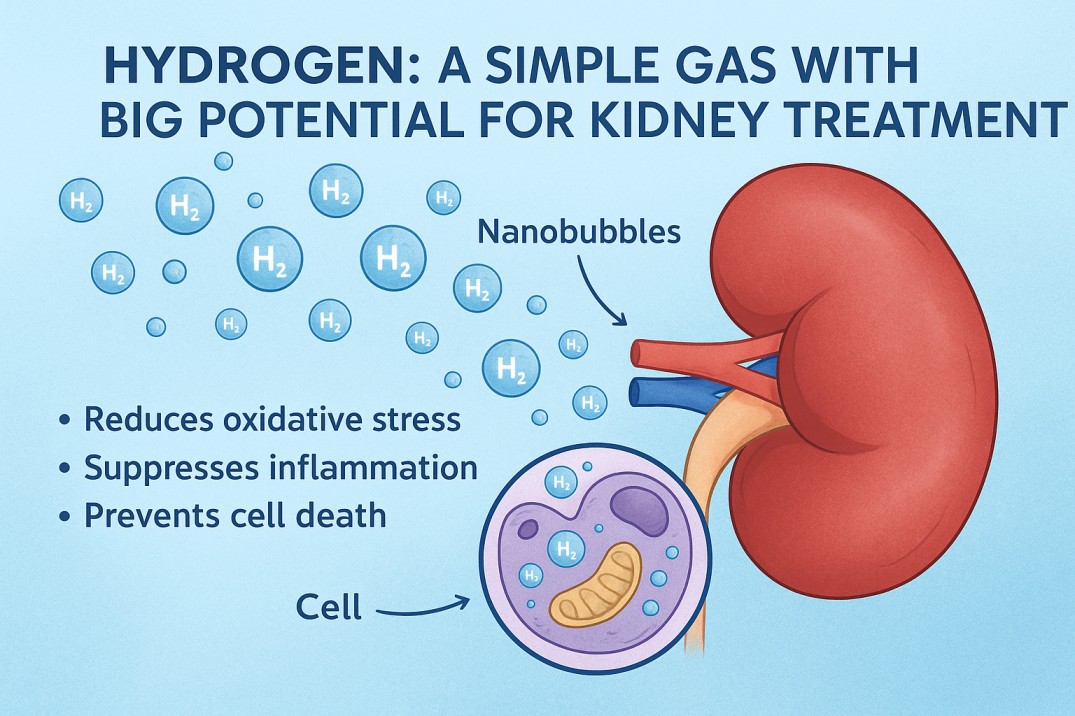
Kidney diseases, ranging from acute kidney injury (AKI) to chronic kidney disease and kidney cancer, are serious health problems worldwide. Current treatments include medications, hemodialysis, and kidney transplantation. While these methods can be effective, they often fall short of addressing damage at the cellular level and restoring kidney function to its fullest potential. Recent research suggests that a simple gas—hydrogen—holds great promise for helping to protect, repair, and even restore impaired kidney function.
What Makes Hydrogen Special?
Hydrogen has antioxidant, anti-inflammatory, and anti-apoptotic (cell death–preventing) properties. Its uniqueness lies in its selective action—it neutralizes only harmful free radicals such as hydroxyl radical (•OH) and peroxynitrite (ONOO−), without disrupting other important signaling molecules needed by the body. Its very small molecular size allows hydrogen to penetrate deep into cells, including the mitochondria—the cell’s energy powerhouse—and the cell nucleus, where it helps protect DNA, maintain energy balance, and reduce oxidative stress.
In modern medical applications, hydrogen is not only administered as gas or dissolved in water, but it can now also be packaged as nanobubbles—ultra-microscopic gas bubbles approximately 100 times smaller than a red blood cell. According to the Institut Molekul Indonesia, nanobubbles have the advantage of being able to cross the blood-brain barrier and enter hard-to-reach tissues, including damaged kidney tissue. These nanobubbles have a stable surface, allowing hydrogen to remain in solution longer, thereby increasing its potential therapeutic effect.
How Hydrogen Protects the Kidneys
Various studies show that hydrogen, whether in liquid form or as nanobubbles, can help reduce oxidative stress, suppress inflammation, protect kidney cells from premature death, and maintain the health of micro blood vessels. In animal models, hydrogen has been shown to reduce kidney damage caused by chemotherapy drugs such as cisplatin, prevent the formation of scar tissue (fibrosis), and improve kidney function after ischemia-reperfusion injury—damage that occurs when blood flow returns after a temporary blockage, such as during kidney transplantation.
In hemodialysis patients, dialysis using hydrogen-enriched fluid has been shown to reduce markers of oxidative stress and may lower the risk of cardiovascular disease. The advantage of hydrogen in nanobubble form also lies in its ability to penetrate target tissues more quickly and effectively. Because of their extremely small size, these hydrogen bubbles can move freely through even the smallest blood vessels, ensuring even distribution and direct contact with cells that need protection. This technology makes hydrogen not just a supportive therapy but also a precise delivery platform for active molecules.
So far, research indicates that hydrogen is safe to use and does not cause significant side effects, whether administered via inhalation, drinking solutions, or nanobubble infusions. However, most evidence still comes from small-scale studies and early trials. Large-scale, well-controlled clinical trials are needed to determine the optimal dose, best delivery methods, and long-term benefits.
Source:
Wang, B., Li, Z., Mao, L., Zhao, M., Yang, B., Tao, X., Li, Y., & Yin, G. (2022). Hydrogen: A novel treatment strategy in kidney disease. Kidney Diseases, 8(2), 126–136.https://doi.org/10.1159/000520981