
Carbon Monoxide: A Toxic Gas That Actually Protects Cells
Carbon monoxide (CO) is often known as a toxic, colorless, and odorless gas that can cause fatal poisoning. Most people are wary of car exhaust or gas stove leaks because of the CO they emit. But did you know that our own bodies actually produce small amounts of CO naturally, and that this gas can actually act as a protector of cells? This is a paradox: a substance deadly at high doses can become beneficial in low amounts. Let’s explore how this so-called toxic gas can offer surprising health benefits to our bodies.
Our Body Also Produces Carbon Monoxide
Carbon monoxide is naturally produced by our cells. This mainly occurs when cells break down heme molecules (a pigment found in red blood cells) through an enzyme called heme oxygenase (HO). When heme is broken down, it produces three byproducts: biliverdin (a green pigment that turns into bilirubin), iron ions, and carbon monoxide. Interestingly, all three products are useful: bilirubin is a powerful antioxidant, the iron is safely stored in ferritin to protect cells, and CO acts as a gas-based signaling molecule (a gasotransmitter) with various biological functions. In other words, our body uses CO as a kind of chemical messenger between cells.
CO production in the body increases during cellular stress. The enzyme HO-1 (heme oxygenase-1) becomes active when cells face oxidative stress or inflammation, resulting in more CO production. Studies have shown that sick patients tend to have higher CO levels in their exhaled breath, and these levels drop again as their condition improves. This suggests that the body releases more CO when under stress – as if CO is part of the body’s natural response to injury or illness. So rather than being just an external poison, CO is also an internal product involved in maintaining cellular balance (homeostasis).
From Poison to Protector: The Cytoprotective Role of CO
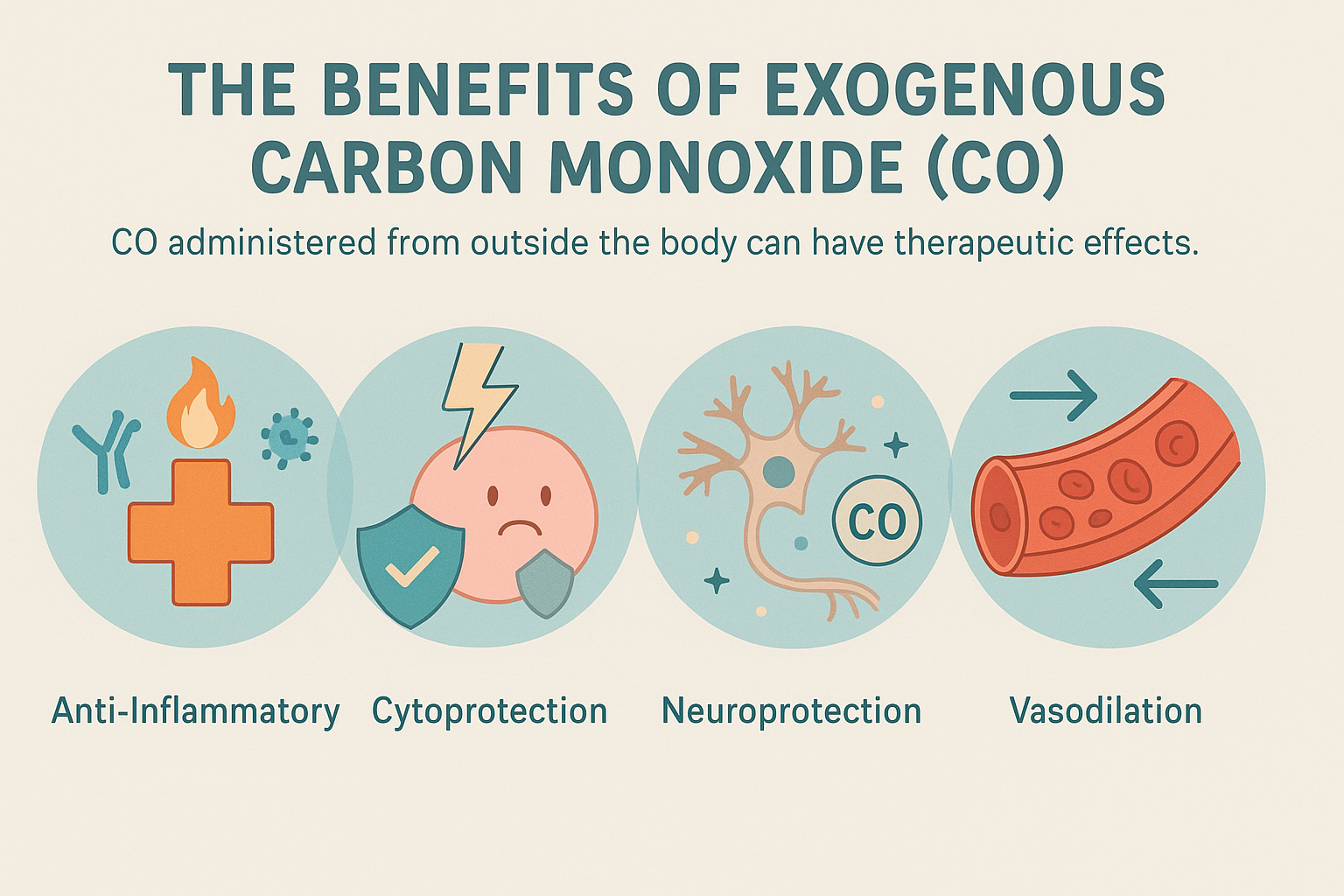
Why does the body make CO in the first place? It turns out that in low doses, CO has various protective (cytoprotective) functions for cells. Scientists have uncovered several key roles that CO plays in protecting our tissues. Among them, CO can prevent premature cell death (anti-apoptotic), reduce excessive inflammation (anti-inflammatory), and help regulate or dilate blood vessels (vasomodulation). This gas also supports the body's functional balance (homeostasis) and can even help cells become more resilient to future stress through a mechanism called preconditioning. In a way, CO “trains” cells like a tiny vaccine—small exposure prepares the cells to handle greater challenges ahead.
CO also affects how cells grow and mature (cell differentiation). All of these effects happen at very low CO concentrations—either produced naturally or given in small, controlled doses. This is a classic case of "the dose makes the poison": in small amounts, CO acts as a protector, but in large amounts, it becomes deadly. It’s a reminder of the old saying: “The dose makes the poison—or the medicine.”
When Natural CO Isn’t Enough: Clinical Conditions That Require More
In daily healthy conditions, the CO produced by the body is usually enough for its signaling functions. But during serious illness or injury, natural CO production may not be sufficient to protect the body. For example, in critical situations such as heart attacks, strokes, or neurodegenerative diseases like Parkinson’s, the body does try to defend itself by producing CO, but this is often not enough to prevent severe damage. In lung transplants, for instance, giving additional CO from outside the body has been shown to reduce bleeding, inflammation, and cell death, leading to better protection of the transplanted organ.
Similarly, in Parkinson’s disease—where brain cells slowly degenerate due to chronic inflammation and oxidative stress—our own CO defenses often can’t keep up. This is where CO therapy comes in. Nanobubble CO technology offers a promising solution, as it delivers CO safely and directly to the brain. The aim is to reduce inflammation, protect neurons, and slow disease progression. This could help improve patients' movement, thinking abilities, and overall quality of life.
Why Do We Need Extra CO From Outside?
Even though the body can make CO, in severe cases like sepsis, organ injury, or autoimmune diseases, natural CO isn’t always enough to protect us. This is where external CO (exogenous CO) plays a role as a helpful supplement. Therapeutic doses of CO can calm excessive immune responses, rebalance inflammation, and prevent damage to tissues.
Beyond that, external CO provides direct protection to stressed or injured organs. It can stop cells from undergoing programmed death (apoptosis) and stimulate the body’s own antioxidants to fight off harmful free radicals. In chronic diseases, CO acts as a reinforced shield against further damage. In neurological conditions like Parkinson’s or stroke, extra CO helps preserve brain cell function and slows down loss of thinking or movement abilities.
CO also helps improve blood flow by gently relaxing blood vessels, making it easier for oxygen and nutrients to reach damaged areas. These benefits have made CO therapy a promising approach for many diseases. Clinical trials have already shown that low, controlled doses of CO are safe for human use. So although we’ve always seen CO as dangerous, it is now emerging as a potential medical therapy of the future—if given in the right way and amount.
Nanobubble Technology: A Safe and Effective CO Delivery System
How can we give CO safely from the outside? Inhaling raw CO gas is obviously risky. That’s where the nanobubble technology comes in. Nanobubble CO is a method of trapping CO gas inside ultra-small bubbles—nanometers in size (about the size of a virus, far smaller than red blood cells). Here's a simple analogy: think of a fizzy drink. Carbon dioxide (CO₂) is trapped in water as tiny bubbles. Similarly, in nanobubble CO, the gas is infused into a liquid in the form of microscopic, stable bubbles that stay suspended throughout the fluid.
When this CO-infused liquid is given (through an IV or injection), the nanobubbles circulate safely through the bloodstream without causing clots or blockages (since they are smaller than blood cells). Once they reach target tissues, they gradually release CO. Because of their tiny size, the nanobubbles can even enter damaged tissues and release CO right where it’s needed. The slow, controlled release helps prevent sudden spikes in blood CO levels, which could be dangerous. Instead, CO gently diffuses to nearby cells and starts working therapeutically—minimizing risk while maximizing benefit. Think of it like a smart capsule that delivers medicine straight to the target.
Nanobubbles ensure CO reaches its destination safely and effectively. They allow precise dosing, avoid dangerous CO buildup in the blood, and tend to focus more on inflamed or damaged areas—just where the body needs help the most. With safe materials and controlled design, nanobubble CO is shaping up to be a promising tool in future medicine.
Sources:
Figueiredo-Pereira C, Dias-Pedroso D, Soares NL, Vieira HLA. CO-mediated cytoprotection is dependent on cell metabolism modulation. Redox Biol. 2020 May;32:101470. doi: 10.1016/j.redox.2020.101470. Epub 2020 Feb 19. PMID: 32120335; PMCID: PMC7049654.http://https://pubmed.ncbi.nlm.nih.gov/32120335/
Ozaki KS, Kimura S, Murase N. Use of carbon monoxide in minimizing ischemia/reperfusion injury in transplantation. Transplant Rev (Orlando). 2012 Apr;26(2):125-39. doi: 10.1016/j.trre.2011.01.004. Epub 2011 Oct 13. PMID: 22000659; PMCID: PMC3261352. https://pubmed.ncbi.nlm.nih.gov/22000659/
Prasetya UB (2024). RSUB and IMI Research Nano Bubble Innovation for Parkinsonism Therapy: "nano bubble technology... safe and effective as an antioxidant, anti-inflammatory and neuroprotective... hoped to improve Parkinsonism... cognitive function... quality of life" https://prasetya.ub.ac.id/en/rsub-dan-imi-teliti-inovasi-gelembung-nano-untuk-terapi-parkinsonism/#:~:text=The%20nano%20bubble%20technology%20used,life%20of%20patients%20with%20Parkinsonism