
A New Hope for Parkinson’s: Taming α-Synuclein with Hydrogen Peroxide
By: Dito Anurogo, M.D., M.Sc., Ph.D.
Imagine if a tiny molecule—once known as a poison—could actually help save brain cells.
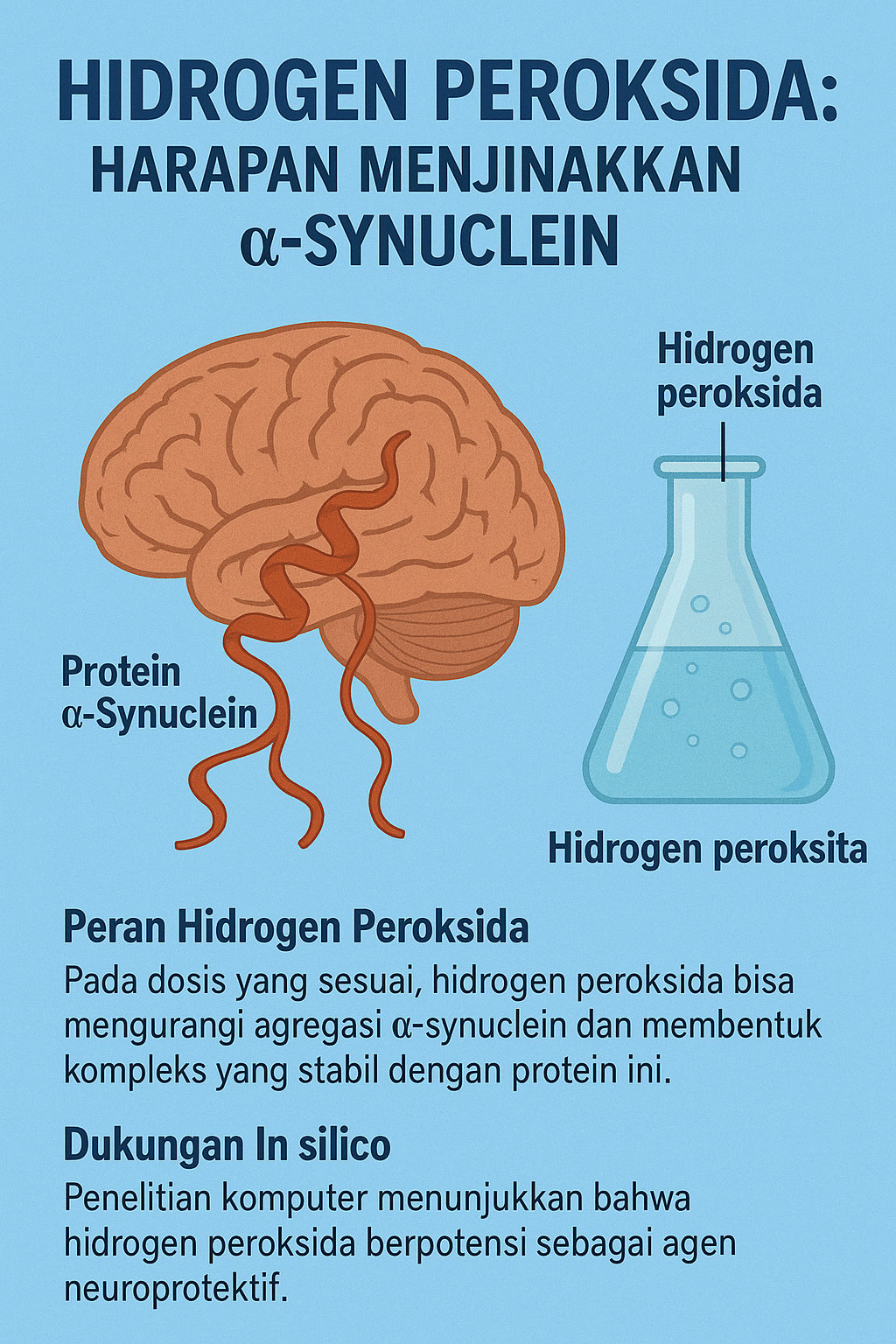
That molecule is hydrogen peroxide (H₂O₂). Yes, the same chemical you may know from antiseptics or hair bleach. In low doses, scientists now believe it could help fight Parkinson’s disease. Could this be the start of a new way to treat brain disorders?
What Is Parkinson’s Disease?
Parkinson’s is the second most common brain disease that worsens over time. It affects movement, causes tremors, stiff muscles, and can lead to memory problems. In 2019, more than 8.5 million people worldwide were living with it. The main cause? A buildup of a sticky protein called α-synuclein (pronounced: alpha-sin-yoo-kleen). This protein clumps together, damages brain cells, and blocks how dopamine works. Dopamine is a brain chemical that helps control movement and mood. Doctors usually treat Parkinson’s with L-DOPA, a medicine that helps the body make more dopamine. But this drug doesn’t stop the damage happening deep in the brain—and over time, it stops working well.
The Culprit: α-Synuclein
α-Synuclein is a natural protein found in the brain. It usually helps control how brain cells talk to each other. But in Parkinson’s, it forms toxic clumps called Lewy bodies. Worse, it spreads like an infection, jumping from one brain cell to another. It sneaks into tiny channels in mitochondria (the cell’s energy center) and blocks them. It also damages proteins that move dopamine around—making everything worse.
The Problem with L-DOPA
L-DOPA seems like a good idea. It helps the brain make dopamine. But there's a catch: it needs energy to work—and when mitochondria are damaged, there’s not enough energy available. Even if dopamine is made, it can’t be recycled properly. This can actually confuse the brain and cause it to make less dopamine naturally. So over time, L-DOPA stops helping.
Hydrogen Peroxide: From Villain to Hero?
Hydrogen peroxide (H₂O₂) is usually seen as harmful. It’s known for producing free radicals, which damage cells. But here’s the twist: in very small amounts, it might protect brain cells instead. New studies show that low doses of H₂O₂ can help cells grow, stop them from dying, and even protect the brain from stress.
Testing with Computers: The In Silico Method
Scientists recently used computer simulations (called in silico studies) to test how H₂O₂ affects α-synuclein and brain cell damage. They created 3D models of brain proteins and watched how H₂O₂ changed their behavior. The results were exciting.
Breaking Down the Clumps
The computer models showed that H₂O₂ stopped α-synuclein from clumping together. It made the protein more wobbly and less sticky. When α-synuclein can’t clump, it can’t form Lewy bodies, which means less damage to the brain.
Protecting Mitochondria
H₂O₂ also made it harder for α-synuclein to stick to the mitochondrial channels (called VDAC). This is a good thing—because if α-synuclein can’t get into mitochondria, it can’t block the brain’s energy supply.
Saving the Dopamine System
Another benefit: H₂O₂ weakened the link between α-synuclein and the dopamine transporter (called DAT). This means dopamine could move around more freely and not pile up dangerously in the brain.
Slowing the Spread
α-Synuclein spreads by attaching to a protein called LRP1, which lets it sneak into new cells. With H₂O₂ present, this connection becomes weaker. That could slow down the disease as it moves through the brain.
Energy and Bonding: The Science Behind the Scenes
When H₂O₂ is present, the bonds between α-synuclein and other brain proteins become weaker and less stable. In this case, that’s exactly what we want—it makes it harder for the toxic protein to do damage.
The Big Picture: A New Treatment Combo?
The study suggests that low-dose hydrogen peroxide could be used alongside L-DOPA. Together, they may help not just replace dopamine but also stop the deeper brain damage that L-DOPA can’t fix alone. Right now, this is all based on computer models. But it’s a promising first step. The next stages will involve lab research and testing on animals—and eventually, maybe even people.
A Molecule of Hope
Science is full of surprises. Sometimes, what we thought was dangerous turns out to be healing. That’s the case with hydrogen peroxide. In the fight against Parkinson’s, this tiny molecule might just be the unlikely hero we’ve been waiting for.
Main Reference
Layla, A., Widyarti, S., & Sumitro, S. B. (2025). In silico study of α-synuclein pathology in Parkinson's disease and the potential of H₂O₂ as complementary therapy. Journal of Pharmacy & Pharmacognosy Research, 13(3), 729–743. https://doi.org/10.56499/jppres24.2122_13.3.729